
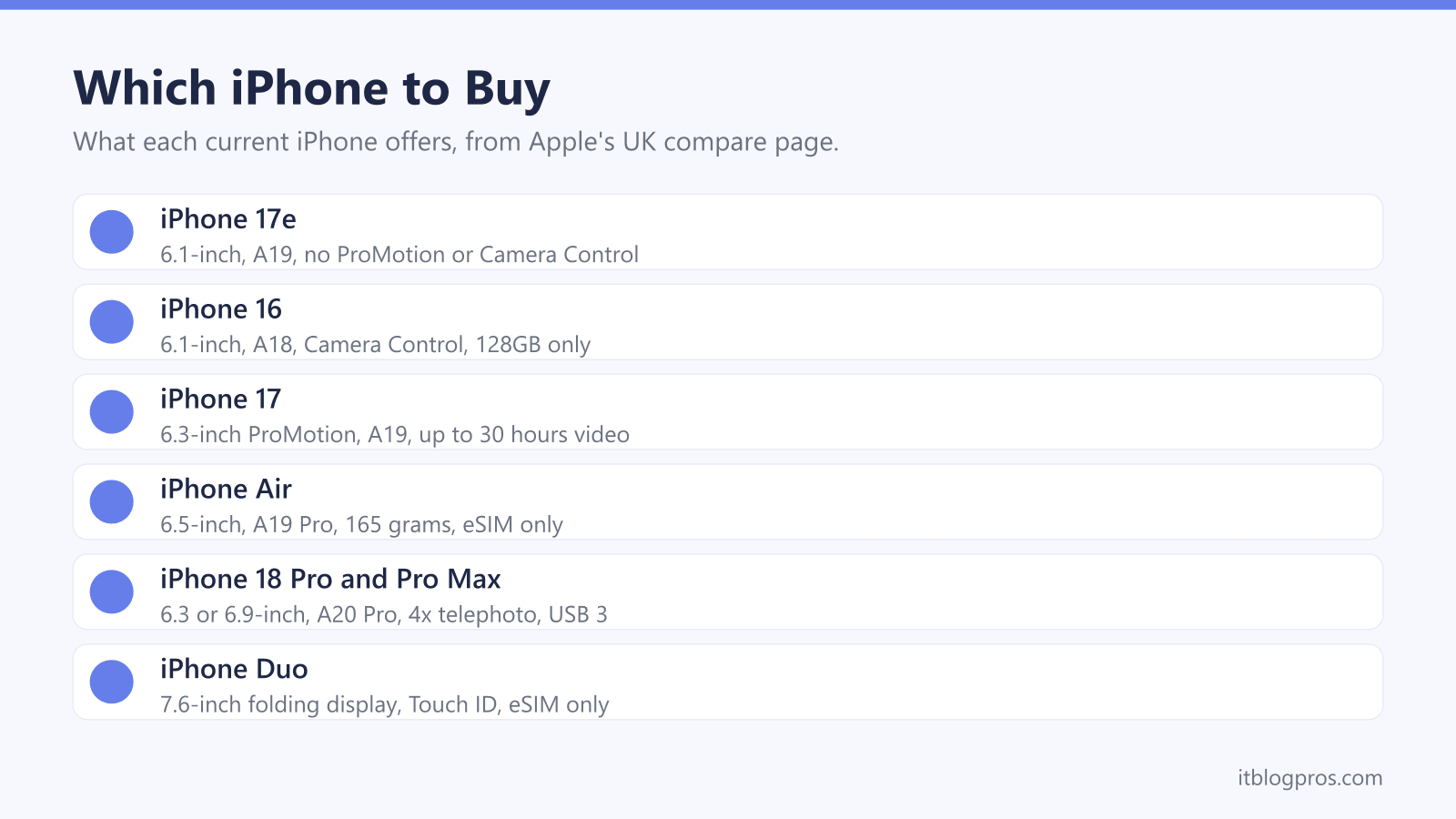
Apple sells seven iPhones in the UK, and the names make the choice harder than it should be. The iPhone 17e, iPhone 16, iPhone 17, iPhone Air, iPhone 18 Pro, iPhone 18 Pro Max and the folding iPhone Duo differ on chip, screen, cameras, battery, buttons and even whether they take a SIM card. This guide takes every difference from Apple's own UK pages, says plainly which older models such as the iPhone 15 Apple no longer sells, and covers charging, refurbished phones and trade-in.
For most people the iPhone 17 is the one to buy: Apple lists the A19 chip, a 6.3-inch ProMotion display, Camera Control, a nano-SIM tray and up to 30 hours of video playback. The iPhone 17e costs less but drops ProMotion and Camera Control. Pick an iPhone 18 Pro model for the 4x telephoto camera, the iPhone Air for the lightest body, or the iPhone Duo for a folding screen.
Key Takeaways
- Apple's UK compare page lists seven iPhones that Apple still sells: the iPhone Duo, iPhone 18 Pro, iPhone 18 Pro Max, iPhone Air, iPhone 17, iPhone 17e and iPhone 16.
- Apple's compare page marks the iPhone 15, iPhone 17 Pro and iPhone 17 Pro Max as available at authorised resellers, and Apple's Apple Intelligence list leaves out the standard iPhone 15.
- Apple's compare page lists ProMotion on every current iPhone except the iPhone 17e and iPhone 16, and Camera Control on every one except the iPhone 17e.
- Apple's UK specs pages give the iPhone 18 Pro models, iPhone 17, iPhone 17e and iPhone 16 a nano-SIM and an eSIM, while the iPhone Air and iPhone Duo are eSIM only.
- Apple's In the Box lists show the iPhone and a 1-metre USB-C Charge Cable with no power adapter, and only the iPhone 18 Pro models and iPhone Duo get USB 3 speeds.
Apple Sells Seven iPhones in the UK
Apple's UK compare page lists seven iPhones that Apple still sells itself: the iPhone Duo, iPhone 18 Pro, iPhone 18 Pro Max, iPhone Air, iPhone 17, iPhone 17e and iPhone 16.
Screen size is the quickest way to sort them. The compare page gives 6.1 inches to the iPhone 17e and iPhone 16, 6.3 inches to the iPhone 17 and iPhone 18 Pro, 6.5 inches to the iPhone Air and 6.9 inches to the iPhone 18 Pro Max. The iPhone Duo folds, and Apple lists a 7.6-inch inner display with a 5.4-inch outer one.
Chips mark the generations. Apple names the A20 Pro for the iPhone Duo and both 18 Pro models, the A19 Pro for the iPhone Air, the A19 for the iPhone 17 and 17e, and the A18 for the iPhone 16. By Apple's figures, weight runs from 165 grams for the iPhone Air to 254 grams for the iPhone Duo. Anyone open to Android can weigh these against the Samsung range, and Apple's tablets get the same treatment in the iPad guide.
The iPhone 15 and iPhone 17 Pro Are No Longer Sold by Apple
Plenty of searches still name older phones, so here is the plain answer. Apple UK still sells the iPhone 16, and its specs page lists a single 128GB capacity. It does not sell the iPhone 15, iPhone 15 Plus, iPhone 16 Plus, iPhone 16e, iPhone 16 Pro, iPhone 17 Pro or iPhone 17 Pro Max: Apple's compare page marks each one as available at authorised resellers.
The iPhone 15 deserves a second thought. Apple's Apple Intelligence support page lists the iPhone Duo, iPhone Air, iPhone 16 models or later, and the iPhone 15 Pro and iPhone 15 Pro Max, and the standard iPhone 15 is not on it. The compare page also gives the iPhone 15 the older A16 Bionic chip and a Ring/Silent switch where newer models have the Action button.
The iPhone 17 Pro Max is a different case. Apple's compare page still lists its A19 Pro chip, 6.9-inch ProMotion display and up to 37 hours of video playback, and Apple's iPhone page says the iPhone 18 Pro Max adds six hours to that.
ProMotion, Camera Control and the Action Button Mark the Cheaper Models
ProMotion is Apple's name for a screen that refreshes at up to 120Hz, which makes scrolling look smoother. Apple's compare page lists it, along with the Always-On display, on the iPhone Duo, both 18 Pro models, the iPhone Air and the iPhone 17. The iPhone 17e and iPhone 16 go without both. The iPhone 17e also skips the Dynamic Island, the pill-shaped cut-out that shows live alerts, and Apple's specs page rates its screen at 800 nits typical brightness against 1,000 nits on the others.
Buttons differ in two places. Camera Control, the touch-sensitive button that opens and adjusts the camera, sits on every current model except the iPhone 17e, and a footnote on Apple's iPhone page names the 17e as excluded. The Action button, which Apple's specs pages say can run Silent Mode, the torch, a shortcut and more, is on every current model except the iPhone Duo, whose specs page lists volume buttons, Camera Control and a side button. That side button holds Touch ID on the Duo, where every other current iPhone uses Face ID.
Rear Cameras Run From One Lens to Three
Every current iPhone has a 48MP main camera, but the lenses around it vary. Apple's specs pages give the iPhone 17e and iPhone Air a single 48MP Fusion camera, which also offers a 12MP 2x telephoto view. The iPhone 17 and iPhone Duo add a 48MP Fusion Ultra Wide, while the iPhone 16 pairs its 48MP main camera with a 12MP Ultra Wide. Macro photography, by the compare page, skips the iPhone Air and iPhone 17e.
Only the 18 Pro models add a dedicated telephoto lens. Apple's iPhone 18 Pro specs page lists a 48MP Fusion Telephoto at 4x, 8x optical-quality zoom, and a main camera with variable aperture from f/1.48 to f/4.0. The compare page also lists Dolby Vision video up to 4K at 120 fps on the 18 Pro models and the iPhone Duo, against 4K at 60 fps on the rest.
On the front, Apple lists an 18MP camera on the iPhone 17, iPhone Air and 18 Pro models, and 12MP on the iPhone 17e, iPhone 16 and the Duo's outer screen.
Battery Life Varies Widely and No Charger Comes in the Box
Apple's compare page quotes battery life as video playback hours: up to 22 hours on the iPhone 16, 26 on the iPhone 17e, 27 on the iPhone Air, 30 on the iPhone 17, 34 on the iPhone 18 Pro and 43 on the iPhone 18 Pro Max. The iPhone Duo is listed at up to 31 hours on its inner display and 44 on the outer one, and Apple's iPhone Air specs page says the separate iPhone Air MagSafe Battery lifts the Air to 40.
Apple's In the Box lists show the iPhone and a 1-metre USB-C Charge Cable, and its specs describe the adapter as available separately. Apple's iPhone 17 specs page quotes up to 50% charge in 20 minutes with a 40W adapter or higher, so a USB-C phone charger belongs in the budget. For MagSafe, Apple lists up to 25W on the iPhone 17, 18 Pro models and iPhone Duo, 20W on the iPhone Air and 15W on the iPhone 17e, and the wireless charger guide covers the plug each speed needs.
The iPhone Air and iPhone Duo Have No SIM Tray
Apple's UK specs pages list Dual SIM, a nano-SIM plus an eSIM, for the iPhone 18 Pro, iPhone 18 Pro Max, iPhone 17, iPhone 17e and iPhone 16, so a physical SIM card still fits. The iPhone Air and iPhone Duo pages list Dual eSIM only and say both are not compatible with physical SIM cards. An eSIM is a digital SIM built into the phone, and Apple's footnote says using one needs a network provider that supports eSIM.
Apple's eSIM support page says eSIM Quick Transfer can move a number from an older iPhone without contacting the network, where the provider supports it, and that some providers can convert a physical SIM to an eSIM.
Port speed is the other hidden split. Apple lists USB 3 at up to 10Gb/s on the iPhone 18 Pro models and iPhone Duo, with a 10Gb/s cable required, and USB 2 at up to 480Mb/s on the iPhone Air, iPhone 17, iPhone 17e and iPhone 16. The gap shows when copying large video files to a computer.
Five iPhones for Different Buyers
Apple's compare page starts every current model at 256GB except the iPhone 16 at 128GB, and Apple's support page says Apple Intelligence needs up to 14 GB free on the iPhone Duo, iPhone Air and 17 Pro models or later, and up to 8 GB on other supported iPhones.
The iPhone 17 is the all-round pick, with ProMotion, Camera Control and a SIM tray. The iPhone 17e is the budget choice, the iPhone Air the lightest, and the iPhone 18 Pro the one for zoom photography and USB 3. The iPhone 17 Pro Max in the table is last year's 6.9-inch Pro model, which Apple no longer sells itself. After that, the earbuds guide and smartwatch guide cover what pairs with it.
Apple's Certified Refurbished page promises genuine Apple replacement parts as needed, a new battery and outer shell, a new box and a one-year limited warranty, and its iPhone listings include older models such as the iPhone 15 Pro. Apple Trade In gives credit for an eligible iPhone or Android phone and recycles the rest free.
| Product | Best for | Key specs | Price | |
|---|---|---|---|---|
 | iPhone 17 256GB, Mist Blue Our pick | Most people: ProMotion, Camera Control and a SIM tray | A19, 6.3-inch ProMotion, up to 30 hours video | Check price → |
 | iPhone 17e 256GB, Black Budget | Apple Intelligence and a SIM tray for less | A19, 6.1-inch display, up to 26 hours video | Check price → |
 | iPhone Air 256GB, Cloud White Lightest | A 6.5-inch screen in a 165 gram body | A19 Pro, 6.5-inch ProMotion, eSIM only | Check price → |
 | iPhone 18 Pro 256GB, Black Best camera | Zoom photography, video and fast USB 3 transfers | A20 Pro, 4x telephoto, up to 34 hours video | Check price → |
 | iPhone 17 Pro Max 256GB, Cosmic Orange Big screen | A 6.9-inch Pro model from last year's range | A19 Pro, 6.9-inch ProMotion, up to 37 hours video | Check price → |