
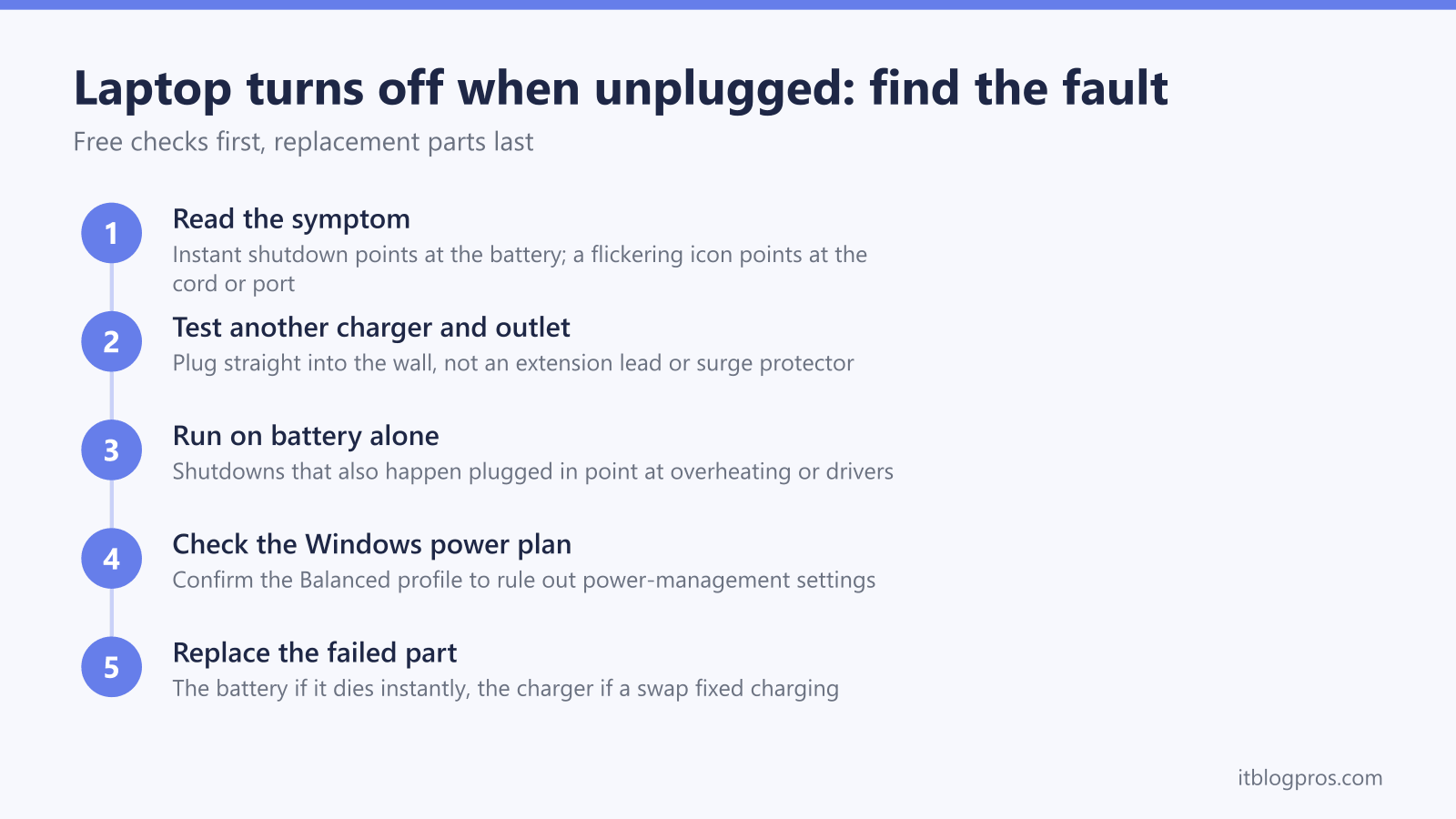
A laptop that turns off the moment you unplug it has a power-delivery fault rather than a software one in most cases. These checks narrow down whether the battery, the charger, or the power settings are to blame, and explain what to do about each. Desktop PCs are not affected, but the underlying causes are worth understanding on any machine.
If your notebook turns off when unplugged then it is unlikely to be caused by a faulty power supply. Your shutdown could be caused by overheating or a faulty power cord that is not supplying the correct voltage to your laptop's battery and not allowing it to charge.
A laptop battery used to be quite a simple component to replace, but as devices have become more sleek and premium in their designs, so too has the difficulty in removing a faulty battery.
It is also possible that your computer's BIOS needs to be updated or the cooling fan in need of repair, which can usually be replaced by technical support specialists if your laptop is still under warranty.
A laptop that turns off when unplugged is living on mains power because its battery is flat, failing, or never charging. The fastest diagnosis costs nothing: test a different charger and wall outlet, watch whether the battery icon flickers between charging and disconnected, and run the laptop on battery alone. A flickering icon points at the port or cord; an instant shutdown points at the battery itself.
Key Takeaways
- A laptop that dies the instant you unplug it almost always has a flat or failing battery rather than a software fault.
- A battery icon that flickers between charging and disconnected points at a dirty charging port, a loose plug, or a damaged cord.
- Testing a different charger and a different wall outlet isolates the fault for free before you spend money on parts.
- Shutdowns that happen even while plugged in point at overheating, Windows corruption, or outdated drivers instead of the battery.
- Windows power-plan settings are worth checking, but they are rarely the cause of a laptop switching off when unplugged.
Brand-specific guides for a laptop switching off when unplugged
- Dell laptop turns off when unplugged
- HP laptop turns off when unplugged
- Apple laptop turns off when unplugged
- Lenovo laptop turns off when unplugged
- Asus laptop turns off when unplugged
A worn or underpowered charger causes a large share of these faults. If your laptop charges over USB-C, the UGREEN 100W GaN charger gives most machines the wattage headroom they need and doubles as a phone and tablet charger; laptops with a barrel-style plug should stay with the manufacturer's original adapter.

The usual reasons a laptop turns off when you unplug it
If your laptop is turning off when you unplug it then there is a fault with the power plug, your power adapter, or your battery. Your laptop should be plugged directly into an outlet, not through an extension cord or surge protector.
Laptop suddenly turns off not charging
If you are experiencing your laptop suddenly turning off and not charging then you are probably dealing with a few problems. Your laptop's charger port might be dirty, or have a bad contact somewhere on the power cord that plugs into your laptop, or on your laptop's power input plug.
If these are the issue, then you will notice that your battery icon is constantly switching from charging to charger disconnected. This means that your laptop's charging feature is never engaged long enough for the battery to charge up fully. If your battery never gets a full and proper charge, then you can start seeing random power down's and switch offs.
To combat this you will need to test your laptop's charging capabilities with a different power adapter. If this has only started happening recently, then you could be lucky and your battery is probably not damaged from incomplete charging cycles. If this has been happening for some time, then your battery could be damaged and might need to be replaced.
When the power cord is fine but the laptop still turns off
If this is the case then you probably have a faulty battery or charger/power adapter. If your laptop shuts down when unplugged then you could have an issue with your battery or your power management profile.
If you unplug your device and you notice that the battery suddenly drains, or when you unplug your charger cable the notebook asks you to power down the device before it switches off on its own.
Reasons a laptop only works with the charger plugged in
This is normally due to a flat battery, which would also reveal itself as your laptop shuts off when unplugged. It is not normal for your laptop to power off when you unplug it, so if this is happening then you are looking at a serious issue. The reason your battery is not charging could be for one of the following reasons:
- faulty battery
- faulty laptop charger
- faulty power cord
- bad charging circuitry on your laptop's motherboard.
Reasons a laptop shuts off even when plugged in
If your laptop is randomly powering off then it could be several issues: Windows Corruption, Power supply problems, or hardware issues. Your laptop can sometimes shut down even if you don't unplug it, which points towards issues like overheating (thermal shutdown or hardware component failure).
Driver problems can also cause your laptop to randomly shut down and reboot.
If your power management settings are not correct then you will have problems with your laptop going into hibernate mode and waking back up again.
Your laptop has a lot of advanced power settings at its disposal, set them up properly for best results
Your laptop might be powering off randomly because it has moisture on its components from environmental humidity, liquid spills or even insect infestation in extreme cases.
It doesn't matter how experienced you are, or how good you are with computers and laptops - a random issue can catch us all by surprise. We want to help you to solve sudden laptop shutdowns by checking the basics.
The main culprit is usually caused by the thermal overload controls on your laptop's motherboard. That means that your critical components like the CPU and chipsets on your laptop's motherboard can usually detect excess heat and then either warn you with a beep or alarm or in extreme cases just shut down entirely.
The issue with cooling and notebooks is that there is an area within the device, which makes airflow a problem.
Most electronic components are very close to one another to save space, which is not always great for system thermals. Our top 5 tips should help you to narrow down the issue, and hopefully, fix it yourself.
IMPORTANT: CHECK YOUR SYSTEM'S WARRANTY AND CHECK IF YOU ARE ELIGIBLE FOR A FREE REPLACEMENT OR REPAIR BEFORE ATTEMPTING ANY REPAIRS
There is probably no worse feeling than when your notebook powers off unexpectedly. Sometimes this is just an inconvenience that happens rarely, or maybe even only once. Other times it can be catastrophic as you can lose the progress of the work that you were busy with.
If the issue starts becoming a regular occurrence then you need to start troubleshooting as soon as you can. This guide helps you figure out what is causing your sudden laptop shutdowns, and how you can try to repair it for yourself. Let's get started!
Starting Point
The first thing to do in the event of a sudden laptop shutdown is to check your cooling system. If your laptop was running for a prolonged amount of time, it is possible that you have issues with your cooling fans or ventilating unit.
Review the location of the fan and/or ventilating unit and look at it for dust build-up, sticker residue, water damage, or anything else obstructing its airflow.
Make sure that the blades are not broken, or bent. If a fan is weak, it will cause your laptop to overheat.
Check the back vents on your laptop for dust or obstructions. Sometimes a small speck of dust can have an adverse effect if your cooling system is not working properly.
Remove any excess heat sinks, and check the thermal paste between each surface and its corresponding chip. If there is no thermal paste, then it's time to add some in.
Windows Corruption
Windows corruption is not fun. It can be a real headache to remedy, and it can cause all sorts of problems for your computer. Windows corruption issues are usually caused by long periods of high CPU usage, or maybe your hard drive is starting to fail.
If you have a sudden shutdown issue while playing video games, then the beginning of the end of your gaming session is probably a good idea to shut down your device.
If you are getting random restarts while using programs or applications, then there might be some corruption in Windows that is causing the problem to occur. You can resolve Windows corruption by running a chkdsk scan on your hard drive. This is a quick and easy tech solution that can get you back into Windows without needing to call anyone out.
If you are having problems with the scanner tool, then you will need to check that the computer is being recognized by your Device Manager (Control Panel > System & Security > Device Manager). If not, then you will need to update your network card and/or sort out any issues there.
Hardware Issues: Laptop Battery and Charge Problems
If you have a hardware issue, the shutdowns may be related to the graphics card. The power cord going into the device may also not fit snugly in the outlet or have loose pins inside of it.
If your notebook is shutting down randomly while plugged in then try checking with another power cord or by using a different one to plug into.
Other hardware issues such as motherboard or video card issues can be another cause for your laptop to randomly shut down. A video card issue might have an effect on the CPU, which could also contribute to a shutdown.
If your laptop is shutting down when you are playing games or performing other CPU-intensive tasks then you should try running a virus scan and defragmentation of your hard drive.
You should also check that you do not have any overheating issues with a laptop cooling pad or by adding more fans to your computer.
There are many reasons why laptops randomly shut down, but most of these issues are easy to fix. It does require some attention and persistence, but it is usually worth it in the long run!
Power Supply Problems
To check if your laptop is suffering from faulty power supply issues, you will need to plug the laptop into a different outlet. If it starts working again then that was the problem! It may be time for an upgrade as well.
You can also check that the power cord is securely plugged into the laptop and the electrical socket. If there is a loose battery connector inside, then you should be able to see it or feel it with your hands.
If your laptop still thinks that it is not getting any electricity, then you will need to look at replacing some of the internal parts. Sometimes a power supply problem for your laptop can cause your battery to go faulty over time, so a battery test is important.
If your laptop still thinks that it should be getting electricity even when you are sure that all parts are properly connected, then there might be a fault with the motherboard.
That is not to say that this will happen in every case. Some motherboards might have electromagnetic interference issues from something like a cordless phone or a wireless router.
It's a good idea to try running your laptop on battery power and checking if it is still shutting down.
Driver Problems
- Laptops are just computers at heart, so they can suffer from many of the same issues that desktop computers do. Drivers are one of those things that can cause huge problems for your laptop without you even being aware of it.
- You will need to go and install new drivers. Sometimes they come preinstalled on the laptop but more often than not, you will need to go out and download them yourself.
- It's always a good idea to put your drivers in a separate folder on your computer in case you ever want to uninstall them again. It will make it much easier to find the right drivers and uninstall them if you ever have a problem with one of them.
- If your drivers are outdated or corrupted then they may not be doing their job correctly. This could contribute to many different issues including random shutdowns.
Power Management Settings
Not many people know this, but your Microsoft Windows installation has a lot of power management settings that make your laptop more efficient when it is not plugged into a charger. If you need to run your device in an area where you need to unplug it, then checking out your power profile is a good idea.
If your laptop is powering off when you unplug it then it is unlikely to be a power management misconfiguration, but it is worth while finding out what your current power profile is.
To find out what your laptop is currently running, do the following. Click on Start, type in "Power" and select the Choose Power Plan option. Then once you have that window open, you can see what your current plan is.
Most people find that the "Balanced" profile is sufficient, so double check what you have selected and turn on the profile that suits your needs the best. From this area, you can edit your power profile and decide what your laptop shut screen action does. This can be set so that the device goes into hibernation, logs out, or does nothing at all.
Final thoughts
Hopefully, these tips can help you narrow down why your laptop is shutting down, laptop turns off, and that you have now resolved issues where your laptop turns off when unplugged.
If you have found your way of diagnosing random shutdown issues then drop us a line and let us know how you managed to remedy the problem yourself without having to pay somebody else to come and repair it for you.
Hopefully you have now found out how to prevent issues and that your laptop no longer shuts down.
Frequently Asked Questions
Reasons a laptop suddenly shuts down. Overheating is the most common cause. Cooling fans carry heat away from the processor, and a fan that is clogged with dust or failing lets the laptop hit its thermal limit and shut down without warning.
The reason a screen goes black on its own. A long period of inactivity makes Windows power settings shut down the display first, then put the computer to sleep. A black screen on its own is usually sleep, not a fault.
A computer that turns off by itself and refuses to restart. A faulty power cord or adapter is the usual culprit. Test the cord with a multimeter or swap in a known-good one; if the laptop starts on a different cord, the old one needs replacing.
Temperature limits for a laptop. Laptops are generally happy in ambient temperatures between 10 and 35 degrees Celsius (50 to 95 Fahrenheit). Internally, Intel puts the maximum junction temperature of its modern processors at 100 to 110 degrees Celsius, and says a processor running a sustained workload may sit at or near that limit by design, throttling its frequency and power to stay under it rather than shutting down.
Stopping random shutdowns. Update the drivers and BIOS, monitor the processor temperature, clean the vents and fans, check the advanced power settings, and run a disk health check. Most random shutdowns are heat or driver related.