Choosing a drone in the UK starts with the rules, because they changed on 1 January 2026. The Civil Aviation Authority now wants a Flyer ID for any drone of 100g or more, and new models carry UK class marks. This guide sets out the CAA's registration rules, the Drone Code's height and distance limits, airport restriction zones, privacy and flying with drone batteries, then compares five drones from DJI and Potensic by weight, camera, sensors and flight time.
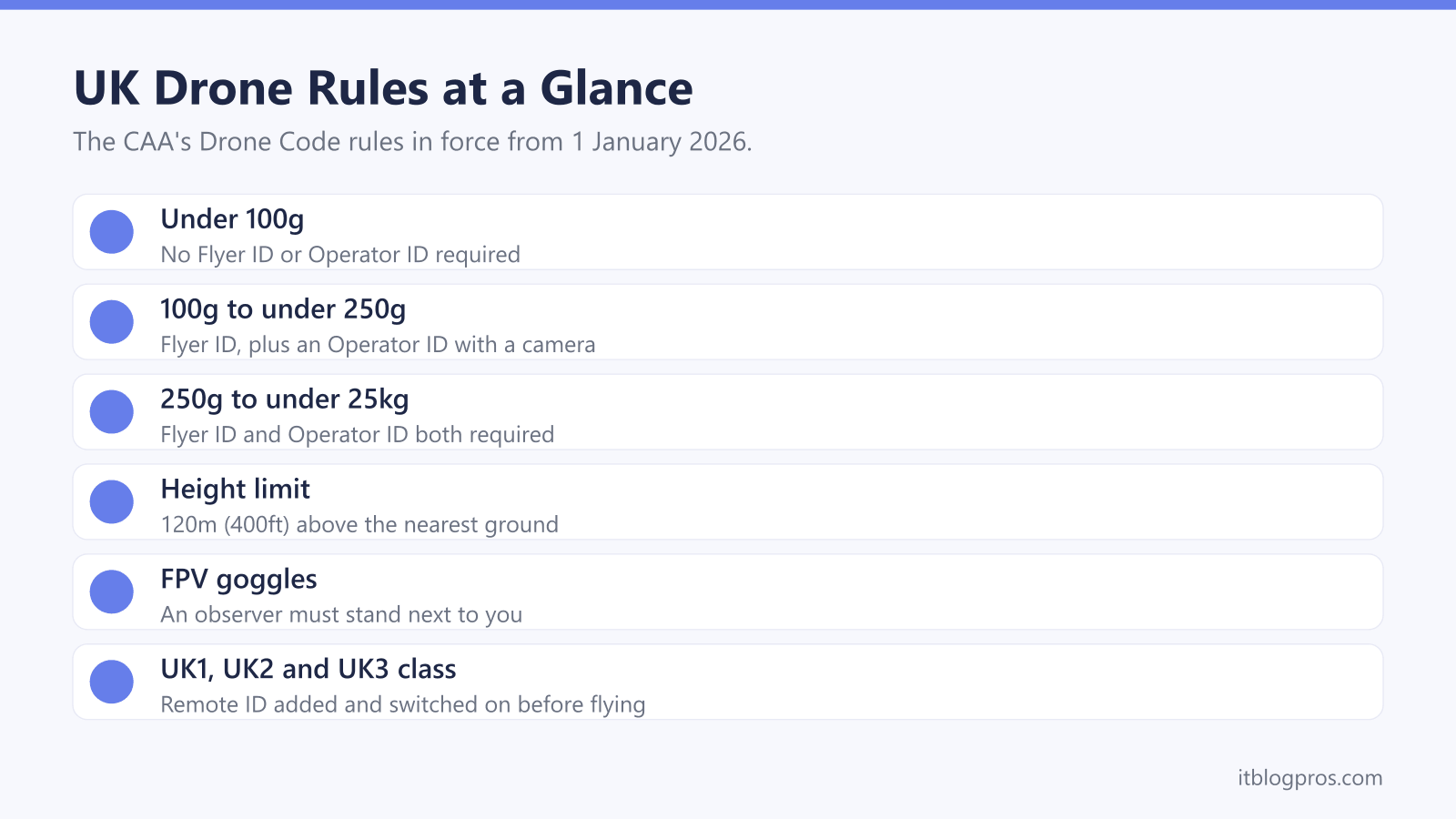
Since 1 January 2026 the CAA has required a Flyer ID for any drone of 100g or more, and an Operator ID for one of 250g or more, or 100g or more with a camera. Fly below 120 metres with the drone in direct sight. A drone under 250g may fly over uninvolved people but never crowds, while most heavier drones keep 50 metres away.
Key Takeaways
- Since 1 January 2026 the CAA has required a Flyer ID for any drone of 100g or more, down from 250g, and the theory test is free.
- The CAA requires an Operator ID for a drone of 250g or more, or 100g or more with a camera, and it lasts one year, carries an annual fee and needs a holder aged 18 or over.
- The Drone Code sets a 120m (400ft) height limit and direct sight of the drone, and flying with FPV goggles needs an observer standing next to you.
- The Drone Code lets a drone below 250g, or a UK0, UK1 or C0 model, fly closer than 50m to uninvolved people and over them, but never over crowds.
- The CAA says drone batteries travel in hand luggage in LiPo-safe bags, and DJI rates the Air 3S battery at 62.5Wh, below the 100Wh point where the CAA's packing guide requires airline approval.
A Flyer ID and an Operator ID Are the UK Drone Licence
The UK has no single drone licence; two registrations with the Civil Aviation Authority do that job. The Flyer ID shows you have passed the CAA's online theory test, and the CAA's Drone Code says you need one to fly any drone of 100g or above. The CAA's announcement of the change says it was 250g until 1 January 2026.
The Operator ID belongs to whoever owns or is responsible for the drone. The Drone Code requires one for a drone of 250g or above, or 100g or above with a camera, which takes in a camera drone as light as DJI's 135g Neo. Below 100g, the CAA says neither ID is needed, though it strongly recommends the test.
The CAA says the test is free and a Flyer ID lasts five years, while an Operator ID lasts one year, carries an annual fee and needs a holder aged 18 or over. Point 31 of the Code says the Operator ID must be labelled on every drone in block capitals taller than 3mm. Flying only indoors needs neither ID.
UK Class Marks and Remote ID Began on 1 January 2026
A class mark shows the safety standard a drone was built to. The CAA's class marks page says any new model placed on the market from 1 January 2026 must carry a UK mark, from UK0 to UK6. UK0 means less than 250g including payload, UK1 less than 900g and UK2 less than 4kg.
The drones here carry European C marks on their makers' spec pages, and the CAA lets those fly as UK equivalents until 31 December 2027, then as legacy drones flown by weight. DJI's UK regulatory page names the Neo, Flip, Mini 5 Pro and Air 3S among models expected to receive UK class updates, and says the Mini 4 Pro does not support them.
Remote ID broadcasts a drone's identity and location to nearby phones. The Drone Code says that from 1 January 2026 you must add your Remote ID and switch it on before flying a UK1, UK2 or UK3 drone. The CAA's Remote ID page adds UK0 and legacy drones of 100g or more with a camera from 1 January 2028.
The Drone Code Sets 120 Metres and Keeps the Drone in Sight
The CAA's Drone and Model Aircraft Code puts the height limit at 120m (400ft) above the nearest ground. Point 2 says to keep the drone in direct sight, clearly enough to tell which way it is facing, and phone screens, tablets and video goggles do not count.
That is the line FPV pilots meet. First-person view means flying from a live camera feed, and the Code says anyone flying that way needs an observer standing next to them who keeps the drone in direct sight. DJI's Neo spec page lists DJI Goggles 3 for live view, so even a palm drone can fly this way.
Distance from people depends on the drone. The Code lets a drone below 250g, or a UK0, UK1 or C0 model, fly closer than 50m to uninvolved people and over them, adding C1 models until the end of 2027. Heavier drones in the Far from People subcategory keep 50m from people and 150m from residential, recreational, commercial and industrial areas. No drone may fly over crowds, and night flying needs a green flashing light.
Airports Have Flight Restriction Zones, So Check the Map First
The Drone Code says most airports, airfields and spaceports have a Flight Restriction Zone, and that you must never fly inside one without permission from the airport, airfield or spaceport. Endangering an aircraft, the CAA warns, can carry a prison sentence of up to five years. The Code gives no single size for these zones, so the boundaries have to come from a map.
For that, the CAA points to NATS' map of airspace restrictions, and NATS' drone page links to interactive maps of current drone restriction zones on its Aeronautical Information Service website. The Code adds that several drone apps show airspace restrictions, and that Notices to Aviation, known as NOTAMs, flag hazards at short notice.
The drone's own app is not enough on its own. The Code says airspace details built into a drone's software may not always be up to date, and a CAA safety notice strongly recommends not relying solely on manufacturers' geo-awareness. Once airborne, point 17 says to lower the drone or land as soon as you hear or see a low-flying aircraft.
Privacy Law Covers What a Drone Camera Records
A camera in the sky can record people who never agreed to it, and the Drone Code treats privacy as part of flying legally. Point 21 says you must respect other people's privacy, and warns that photos or recordings may be covered by the General Data Protection Regulation. Flying where people expect privacy, the Code adds, is likely to break data protection laws.
The rest of that section is practical. Know how far the camera zooms and what quality it records, tell people before recording where that is practical, think before posting footage on social media, and keep images secure while deleting what you do not need.
The Information Commissioner's Office, which enforces data protection law, separates hobbyists using a drone for purely personal activities from organisations, which it says are controllers of any personal data their drones capture. Its drone guidance also warns that people can be identified from the context of footage or through the camera's zoom, even when they are not its subject. Anyone flying for a business should read that guidance in full.
Under 250g, the Camera and Gimbal Decide the Shortlist
Weight now decides where a drone can fly rather than whether it needs registering. DJI's Lito 1 page says its weight allows flying without registration or exams in most countries and regions, but under the CAA's 100g rule the UK is not one of them. Staying under 250g still opens up flying near and over uninvolved people, and in towns.
DJI lists the Flip at under 249g and the Lito 1 at approximately 249g, while Potensic gives the ATOM 2 as under 249g. DJI's 135g Neo launches from a palm without a controller, propeller guards included. The 724g Air 3S carries the C1 mark, so it shares those places only until the end of 2027 unless its UK class update arrives.
For steady video, look for a 3-axis mechanical gimbal, the motorised mount that keeps footage level. DJI gives the Flip, Lito 1 and Air 3S one, and Potensic the ATOM 2, while the Neo has a single-axis gimbal with electronic stabilisation. DJI's guide says the Lito 1 records only to microSD, which the SD card guide covers.
For a camera on a helmet or bike instead, the action camera guide compares GoPro, DJI and Insta360.
Flight Time, Obstacle Sensing and Wind Ratings Are Makers' Figures
Flight times are makers' figures, from DJI's wind-tunnel tests and Potensic's windless tests at 5 m/s. Their pages list about 18 minutes for the Neo, 31 for the Flip, 32 for the ATOM 2, 36 for the Lito 1 and 45 for the Air 3S. DJI's UK store lists one battery and an RC-N3 controller, which runs DJI Fly on your own phone, in the standard Lito 1 and Air 3S kits.
For obstacle sensing, DJI lists omnidirectional vision on the Lito 1 and Air 3S and forward infrared on the Flip, while the Neo and ATOM 2 spec pages list only downward positioning sensors. Wind ratings run from 8 m/s on the Neo to 12 m/s on the Air 3S, and the Drone Code warns that wind at height often differs from the ground.
On a plane, the CAA says drone batteries go in hand luggage in LiPo-safe bags. DJI rates the Air 3S battery at 62.5Wh, and the CAA's packing guide requires airline approval only from 100Wh. The power bank guide covers power banks.
| Product | Best for | Key specs | Price | |
|---|---|---|---|---|
 | DJI Flip with DJI RC 2 screen remote controller Our pick | Sub-250g filming with a screen controller | Under 249 g, 1/1.3-inch sensor, 3-axis gimbal, 31 min | Check price → |
 | DJI Lito 1 (standard) Beginner | A first drone with all-round obstacle sensing | Approx. 249 g, omnidirectional sensing, 36 min, microSD | Check price → |
 | Potensic ATOM 2 (Standard Kit) Budget | A sub-250g gimbal drone for less | Under 249 g, 1/2-inch sensor, 3-axis gimbal, 32 min | Check price → |
 | DJI Neo (controller-free) Palm and selfie | Palm launches and follow-me selfie clips | 135 g, 1/2-inch sensor, single-axis gimbal, 18 min | Check price → |
 | DJI Air 3S (DJI RC-N3) Higher end | Two cameras and the longest flights here | 724 g, 1-inch and 1/1.3-inch cameras, 45 min, C1 | Check price → |