
A paper shredder cuts old bank statements, bills and letters into pieces too small to put back together, which keeps your name and address out of the recycling bin. Report Fraud, the police service formerly called Action Fraud, says criminals often steal identity details by taking documents from people's rubbish. This guide explains the P-levels as Fellowes, Rexel and HSM describe them, then sheet capacity, run time, bin size, auto feed, safety and oiling, and ends with five home shredders.
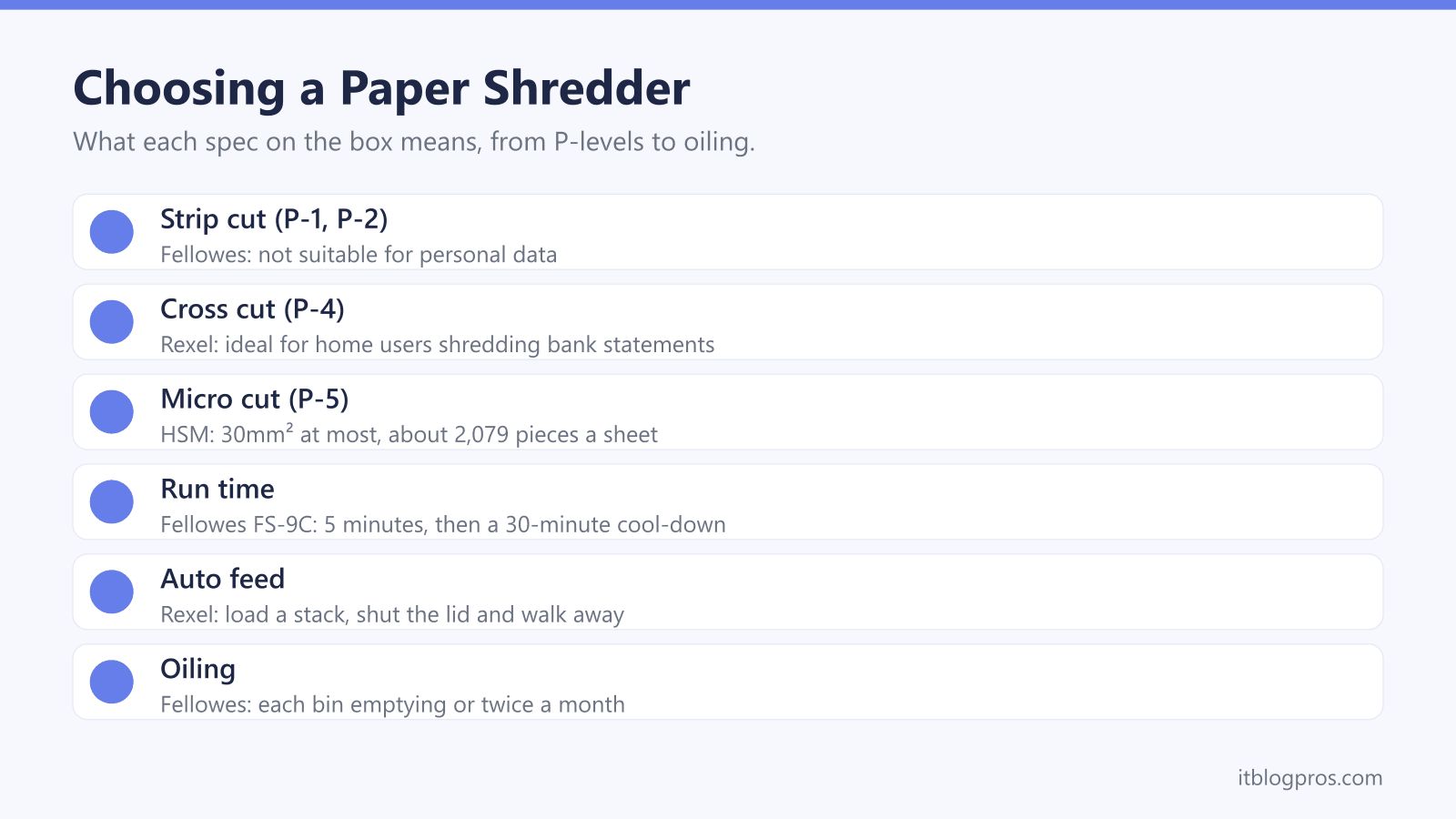
For bank statements and letters at home, choose P-4 or higher. Rexel calls P-4 ideal for home users shredding bank statements, HSM recommends P-4 or higher for personal data under GDPR, and Fellowes recommends P-5 micro cut in most instances. Avoid strip cut: Fellowes says P-1 and P-2 strips are not suitable for personal data. Then match sheet capacity and run time to the size of your pile.
Key Takeaways
- Report Fraud says criminals often steal identity details by taking documents from rubbish, and advises shredding anything with your name, address or financial details before throwing it out.
- HSM lists a maximum particle of 160mm² for P-4 and 30mm² for P-5 under ISO/IEC 21964 (DIN 66399), so a higher P-number always means smaller pieces.
- Rexel calls P-4 ideal for home users shredding bank statements, while Fellowes says P-1 and P-2 strip cut is not suitable for personal data.
- Home shredders run in short bursts: Fellowes lists the FS-9C at up to 5 minutes followed by a 30-minute cool-down, and Rexel says Momentum cool-downs can last up to 60 minutes.
- Fellowes says to oil a cross cut or micro cut shredder each time the bin is emptied or at least twice a month, and never with an aerosol oil, which it calls a serious fire hazard.
Shredding Keeps Your Name and Address Out of the Bin
Report Fraud, the City of London Police service formerly called Action Fraud, defines identity theft as fraudsters gathering enough about someone, such as a name, date of birth and current or previous addresses, to commit identity fraud. Its identity fraud page says this is often done by taking documents from your rubbish. The advice that follows is plain: do not throw out anything with your name, address or financial details without shredding it first.
The same page names the paperwork. Report Fraud says not to throw away entire bills, receipts, card slips, bank statements or even unwanted post in your name, and to destroy them, preferably with a shredder. The ICO's identity theft page agrees, telling people to shred or destroy old documents so that nothing showing a name, address or other personal details can be taken, and to keep a driving licence, passport and bank statements somewhere safe.
Paper printed at home counts as well. A statement downloaded and run off on a home printer carries the same details as the one the bank posts.
P-Levels Measure How Small the Pieces Are
The P-number on a shredder box comes from a standard. HSM, which makes shredders, names it ISO/IEC 21964 (DIN 66399) and lists a maximum size for each paper level. P-1 and P-2 are strips, at most 12mm and 6mm wide. From P-3 the limit becomes an area: HSM lists 320mm² for P-3, 160mm² for P-4 and 30mm² for P-5, which it works out at about 194, 389 and 2,079 particles from one A4 sheet. P-6 and P-7 go smaller again, for secret and top secret material.
Fellowes says DIN 66399 arrived in 2012 and groups the levels into three protection classes. HSM describes class 2, covering P-3 to P-5, as the one for confidential data where a breach could harm a person's social or financial position, and Fellowes recommends class 2, at P-4 or P-5, for most shredding needs.
Rexel rounds its counts differently, at 200 pieces for P-3, 400 for P-4 and 2,000 for P-5. The order never changes, though: the higher the P-number, the smaller the pieces.
Strip Cut Is the One to Avoid for Bank Statements
Rexel explains the cut types plainly. Strip cut slices documents into long vertical strips, which Rexel says are far more easily reassembled than cross cut or micro cut shreds, while a cross cut shredder also cuts across the page. Fellowes puts strip cut at P-1 and P-2, 36 strips per A4 sheet, and says it is not suitable for personal data.
Fellowes then splits the rest three ways. Its cross cut, at P-3 and P-4, gives at least 300 particles a sheet for sensitive papers such as delivery notes with an address. Mini-cut, Fellowes' name for a finer P-4, gives at least 1,000 and suits account numbers and invoices, and micro cut at P-5 gives at least 2,000.
For a home, P-4 is the floor the makers point to. Rexel calls P-4 ideal for home users shredding bank statements and keeps P-3 for junk mail and delivery notes, HSM recommends P-4 or higher to meet GDPR, and Fellowes advises businesses never to go below P-4. Old postage labels carry an address too, including any printed on a label printer.
Sheet Capacity, Run Time and Bin Size Set the Pace
Sheet capacity depends on paper weight: Fellowes rates the 6M with 70gsm paper and Rexel rates the AutoFeed+ 50X with 80gsm. In Fellowes' own home range, the P-4 cross cut FS-9C takes 9 sheets a pass and the finer P-4 mini-cut 6M takes 6. Rexel says higher sheet capacity shredders allow for quicker shredding.
Run time is the catch on small machines. Fellowes lists the FS-9C at up to 5 minutes of continuous shredding followed by a 30-minute cool-down. Rexel says its Momentum shredders run for 3 or 6 minutes depending on the model, with a cool-down that can last up to 60 minutes. Fellowes' FAQ says to wait about 30 minutes if the overheat light comes on.
For the bin, Rexel advises choosing by the number of sheets it holds rather than litres alone, and notes that a higher security level means a smaller cut size and increased bin capacity. Among the Fellowes models here, the 6M has a 13 litre bin under a lift-off head and the 10M a 19 litre pull-out bin.
Auto Feed Lets You Load a Stack and Walk Away
An auto feed shredder pulls sheets from a stack in a closed chamber by itself. Rexel says users load a stack, shut the lid and walk away, with the closed chamber keeping noise down, and it claims its auto feed models save 98% of the time spent hand feeding a standard shredder.
The Rexel Optimum AutoFeed+ 50X shows the format at home size: 50 sheets of 80gsm A4 in the auto feed, a manual slot for up to 6 sheets, P-4 cross cut particles of 4x28mm and a 20 litre pull-out bin. Rexel lists a 10-minute run with fan cooling and 55 dBA. Fellowes' AutoMax 90M takes 90 sheets in the feed and 9 by hand, cuts finer at a 4x12mm P-4 mini-cut, and Fellowes says it shreds the full 90 sheets in approximately 5 minutes within a 10-minute run time.
Bulk is the trade-off. Fellowes lists the AutoMax 90M at 51.5cm tall and 8.8kg, against 40.1cm and 3.9kg for the FS-9C. On larger models, Rexel adds a 4-digit PIN lock to the paper chamber.
Safety Locks, Sensors and Oil Keep a Home Shredder in Order
For homes with children or pets, Fellowes offers two safety features. Fellowes' Safety Lock, on the FS-9C, 6M and 10M, manually disables the shredder to prevent accidental activation. SafeSense, on other Fellowes models, is a sensor that Fellowes says stops shredding when hands or paws touch the paper entry. Fellowes' FAQ also says to switch off before touching the bin, because the cutters may restart.
What goes in matters too. Fellowes lists staples, paper clips and credit cards for the FS-9C, 6M and AutoMax 90M, and staples and credit cards for the 10M. Rexel says many of its models take CDs and cards, but its AutoFeed+ 50X page lists credit cards, staples and paper clips, not CDs.
Cross cut and micro cut blades need oil, and Fellowes says strip cut shredders do not. Fellowes advises oiling each time the bin is emptied or at least twice a month, with a vegetable oil, and warns that aerosol oils such as WD40 are a serious fire hazard. Rexel suggests shredding an oiling sheet once a month on its Momentum range.
Five Home Shredders for Statements, Post and Big Clear-Outs
A shredder covers only the paper side of identity fraud. Report Fraud's advice also covers fake calls from banks, checking statements and asking Royal Mail to redirect post for at least a year after moving house, and no shredder changes any of that. None of the five below lists CDs either.
The Fellowes Powershred FS-9C is the everyday pick: 9 sheets of 4x37mm P-4 cross cut, a 17 litre bin and the Safety Lock, with the 5-minute run and 30-minute cool-down covered above. Fellowes lists the same specs for the black Powershred LX50. The Powershred 6M trades capacity for smaller pieces, with 6 sheets of 4x12mm mini-cut and a 13 litre bin, though its Fellowes page gives a 1-year machine warranty in the bullet points and 2 years in the spec table.
For P-5, the Powershred 10M cuts 10 sheets into 2x12mm particles, runs for up to 10 minutes and carries a 5-year cutter warranty. For a backlog of old statements, the Rexel AutoFeed+ 50X and Fellowes AutoMax 90M feed themselves, at P-4 cross cut and P-4 mini-cut respectively.
| Product | Best for | Key specs | Price | |
|---|---|---|---|---|
 | Fellowes Powershred FS-9C Cross-Cut Shredder (White) Everyday pick | Everyday post and bank statements in most homes | 9 sheets, P-4 4x37mm cross cut, 17L bin, 5 min run | Check price → |
 | Fellowes Powershred 6M Mini-Cut Shredder Compact | Light use, with smaller pieces than standard cross cut | 6 sheets, P-4 4x12mm mini-cut, 13L bin, 5 min run | Check price → |
 | Fellowes Powershred 10M Micro-Cut Shredder P-5 micro cut | Medical and financial papers, cut to P-5 | 10 sheets, P-5 2x12mm micro-cut, 19L bin, 10 min run | Check price → |
 | Rexel Optimum AutoFeed+ 50X Cross Cut Shredder Auto feed | Clearing a backlog of old statements hands-free | 50-sheet auto feed, P-4 4x28mm cross cut, 20L bin | Check price → |
 | Fellowes AutoMax 90M Mini-Cut Shredder Bigger auto feed | Big clear-outs, with a finer mini-cut | 90-sheet auto feed, P-4 4x12mm mini-cut, 17L bin | Check price → |