Every fitness tracker counts steps and watches your heart rate, so the differences that matter sit in the small print: how long the battery lasts, whether GPS is built in, which phones the app supports and what sits behind a subscription. This guide puts Fitbit, Garmin, Amazfit, Xiaomi and Samsung side by side on each of those points, in the makers' own words and figures, then covers when a smartwatch makes more sense and which five trackers suit which buyer.
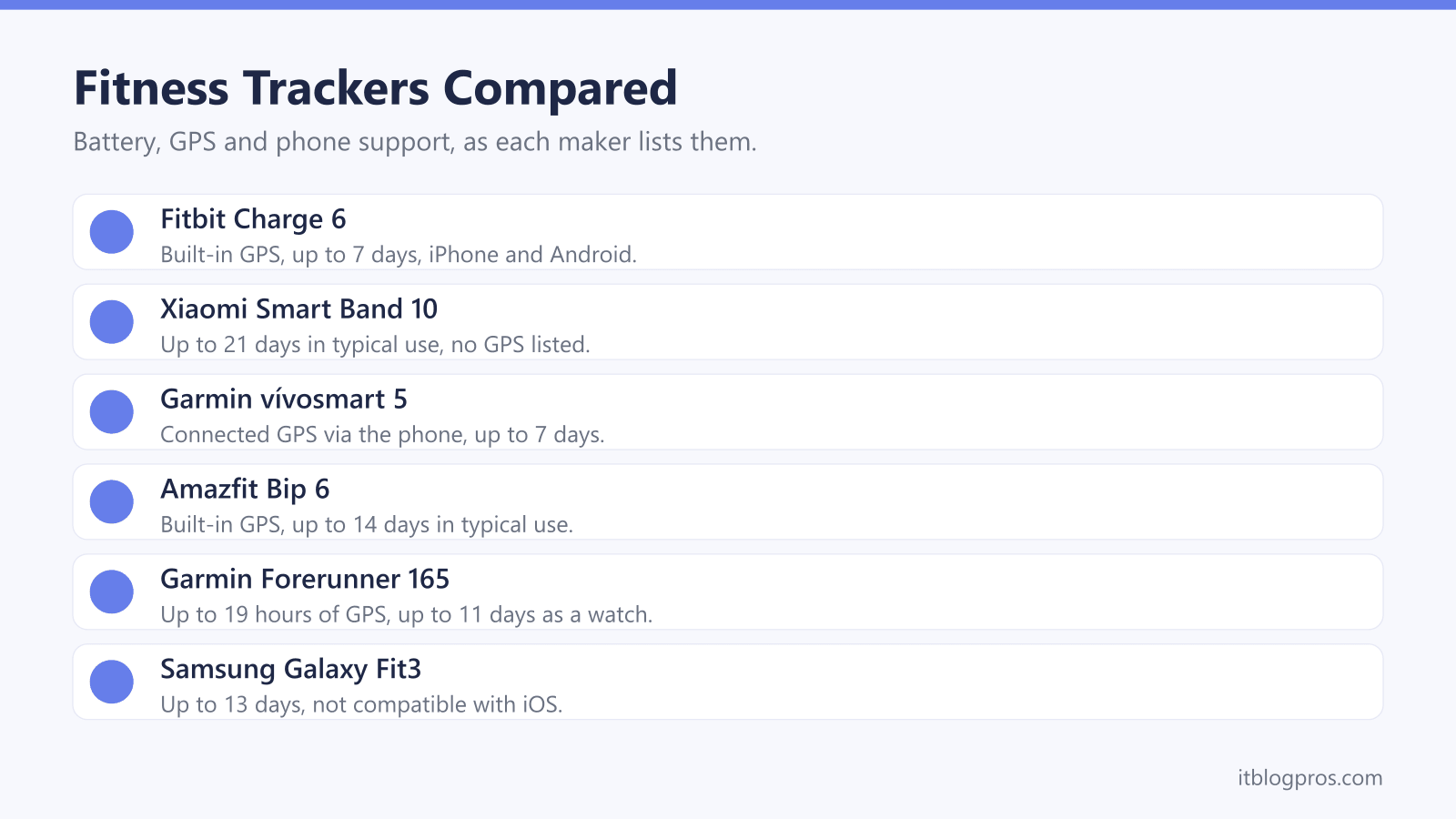
For most people, a band with built-in GPS such as the Fitbit Charge 6 is the sensible middle ground: Google lists up to 7 days of battery and support for both iPhone and Android. Xiaomi's Smart Band 10 claims up to 21 days in typical use for less, but lists no GPS. Choose a smartwatch only for apps, calls or payments, and check it supports your phone first.
Key Takeaways
- Battery figures are the makers' own: Xiaomi quotes up to 21 days for the Smart Band 10 in typical use, Samsung up to 13 days for the Galaxy Fit3 and Google up to 7 days for the Fitbit Charge 6.
- The Fitbit Charge 6, Amazfit Bip 6 and Garmin Forerunner 165 have built-in GPS, while Garmin's vívosmart 5 borrows the phone's GPS and needs the phone in range.
- Every maker here describes its health readings as wellbeing tools: Google says only a doctor can diagnose AFib, and Garmin says Pulse Ox is not a medical device.
- Samsung says the Galaxy Fit3 and Galaxy Watch9 do not pair with an iPhone, while Fitbit, Garmin, Amazfit and Xiaomi list both iOS and Android support.
- Subscriptions add coaching rather than the basics: Garmin says existing Garmin Connect features stay free, and Google Health Premium adds a coach built with Gemini.
Battery and Water Ratings Come With Small Print
The makers' battery figures spread widely. Xiaomi quotes up to 21 days for the Smart Band 10 in typical use, falling to 9 days with the always-on display and 8 under heavy load. Samsung gives the Galaxy Fit3 up to 13 days with the always-on display off and 3.5 days with it on. Amazfit lists the Bip 6 at up to 14 days in typical use, or 6 under heavy use. Google rates the Fitbit Charge 6 at up to 7 days and warns the always-on display and SpO2 features need more frequent charging, and Garmin gives the vívosmart 5 up to 7 days in smartwatch mode.
These are lab numbers: Xiaomi and Samsung cite their own internal tests, and Amazfit says real use may differ.
Water ratings look alike, with Fitbit, Garmin, Amazfit, Xiaomi and Samsung all rating these models at 5 ATM, which Xiaomi equates to 50 metres. Even so, Xiaomi rules out hot showers, saunas and diving, Samsung limits the Fit3 to 50 metres for 10 minutes, and Google says the Charge 6 is not waterproof.
Built-In GPS Lets You Leave the Phone at Home
GPS splits the field more clearly than any other feature. A tracker with its own receiver can map a run or ride by itself; one without has to borrow the phone's.
Three models in this guide have it built in. Google lists GPS plus GLONASS on the Fitbit Charge 6 and says it shows pace and distance with no phone needed. Amazfit says the Bip 6 connects to five satellite systems and quotes up to 32 hours of continuous GPS use. Garmin's Forerunner 165, a running watch rather than a band, lists up to 19 hours in GPS-only mode and up to 11 days in smartwatch mode.
Garmin's vívosmart 5 takes the other route. Its manual describes connected GPS, which uses the GPS antenna in your phone for walks, runs and rides, and says the phone must stay in range or no GPS data is recorded. The spec lists for the Xiaomi Smart Band 10, Samsung Galaxy Fit3 and Fitbit Inspire 3 name no GPS at all, which matters most to anyone who runs or cycles without a phone.
Heart Rate and Sleep Data Are for Wellbeing, Not Diagnosis
Optical heart rate and sleep tracking come on every model here, and each maker lists a blood oxygen (SpO2) reading. Google says the Charge 6 tracks time in light, deep and REM sleep. Amazfit lists sleep stages including REM, plus naps, for the Bip 6. Samsung says the Galaxy Fit3's snoring detection uses the microphone on a paired Galaxy phone.
The small print is consistent. Google says the Charge 6's SpO2 sensors are not intended to diagnose or treat any medical condition. Garmin says Pulse Ox is not a medical device, Amazfit says the Bip 6 and the Zepp App cannot be used as a basis for diagnosis, and Xiaomi says the Smart Band 10's features are not designed for medical purposes. Samsung describes the Fit3's sleep features as general wellness only.
The Charge 6 goes furthest with an ECG app, which Google's help page lists for the UK. Google says the app analyses heart rhythm for signs of AFib, that it cannot detect all heart conditions, and that only a doctor can diagnose AFib.
The Phone You Own Narrows the Shortlist
Every tracker leans on a phone app, so compatibility is the first filter. Google says Fitbit trackers need the Google Health app, which has replaced the Fitbit app, on iOS 16.4 or Android 11 or newer, plus a Google account. Amazfit lists Android 7.0 and iOS 14.0 for the Bip 6, Xiaomi lists Android 8.0 and iOS 14.0 for the Smart Band 10, and Garmin lists iPhone and Android for the vívosmart 5 and Forerunner 165.
iPhone owners still lose a few extras. Garmin limits text replies to Android, and Xiaomi says quick message replies need an Android phone.
Samsung is the exception. Its watch compatibility support page says the Galaxy Fit3 is not compatible with iOS. Samsung is inconsistent about Android too: a footnote on its UK Fit3 page says the band must be paired with a Samsung Galaxy phone on Android 10, while that support page lists other Android 10 phones as compatible.
Google adds that Fitbit syncing needs Bluetooth and an internet connection, so the phone won't connect to WiFi guide helps when syncing stalls.
Subscriptions Add Coaching on Top of Free Apps
Two of the five brands sell a subscription, both as an extra. Google's Google Health Premium page lists sleep stages, heart rate, HRV, SpO2 and skin temperature among the free Google Health app's features with a Fitbit. Premium adds Google Health Coach, which Google says is built with Gemini, plus advanced Health Guardian features and video workouts. Google says members must be over 18, and the Charge 6 page offers three months of Premium.
Google is not consistent on one point: its Premium page lists readiness in the free app, yet the Charge 6 page marks the Daily Readiness Score as a Premium feature.
Garmin's announcement of Garmin Connect+ says all existing features and data in Garmin Connect will remain free. Connect+ adds AI insights, a performance dashboard and extra LiveTrack features, and Garmin's UK page sells it as a monthly or annual plan after a free trial. The Amazfit, Xiaomi and Samsung pages for these models do not mention a subscription. The video doorbell without a subscription guide covers the same question for home cameras.
A Smartwatch Trades Battery Life for Apps, Calls and Payments
A smartwatch earns its extra charging when apps, calls or payments matter more than battery life. Google's own comparison shows the trade clearly. It lists the Pixel Watch 5 with Wi-Fi, LTE and the full suite of Google apps, but up to 40 hours of battery with the always-on display. Google's Fitbit Edge tracker gets up to seven days, with its on-device apps limited to weather and media controls.
The phone matters even more with a smartwatch. Google lists the Pixel Watch 5 as Android only. Samsung says the Galaxy Watch9 works with Galaxy phones and other supported Android phones, and that pairing with iPhones is not supported. On the other side, Apple's compatibility table matches every Apple Watch to an iPhone, with the Series 12 needing an iPhone 11 or later on iOS 27.
Some trackers already cover part of the gap. Amazfit says the Bip 6 makes and answers Bluetooth calls while still quoting up to 14 days of battery, and Google lists Google Wallet payments on the Charge 6.
Five Trackers Cover Most Wrists
First, the limits. By each maker's own description none of these is a medical device, and a band without GPS cannot map a run without the phone. Support periods also differ: Google promises at least two years of security updates after the Charge 6 is last sold on its store, while the security update dates on Garmin's UK pages for the vívosmart 5 and Forerunner 165 have already passed.
With that said, the table below covers the usual cases. The Fitbit Charge 6 is the all-round pick, with built-in GPS, the ECG app and support for iPhone and Android. Xiaomi's Smart Band 10 is the budget choice for battery life, though Xiaomi lists no GPS. Garmin's vívosmart 5 suits anyone who wants Garmin Connect in a slim band and will carry the phone for GPS. The Amazfit Bip 6 adds built-in GPS and Bluetooth calls, though Amazfit packs a charging head and no cable. Garmin's Forerunner 165 is for runners who want up to 19 hours of GPS.
| Product | Best for | Key specs | Price | |
|---|---|---|---|---|
 | Fitbit Charge 6 Our pick | Built-in GPS and the ECG app on iPhone or Android | Built-in GPS, up to 7 days, water resistant to 50 m | Check price → |
 | Xiaomi Smart Band 10 Budget | Long battery life and sleep tracking for less | Up to 21 days typical use, 5ATM, Android and iOS | Check price → |
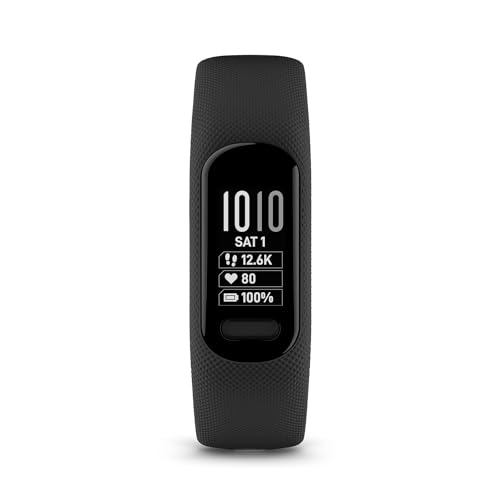 | Garmin vívosmart 5 (Large) Slim band | Garmin Connect in a slim band, phone carried for GPS | Connected GPS, up to 7 days, swim rated, iPhone/Android | Check price → |
 | Amazfit Bip 6 GPS for less | Built-in GPS and Bluetooth calls on a budget | Built-in GPS, up to 14 days typical use, 5 ATM | Check price → |
 | Garmin Forerunner 165 For runners | Runners who leave the phone at home | Up to 19 hours GPS-only, up to 11 days smartwatch mode | Check price → |