
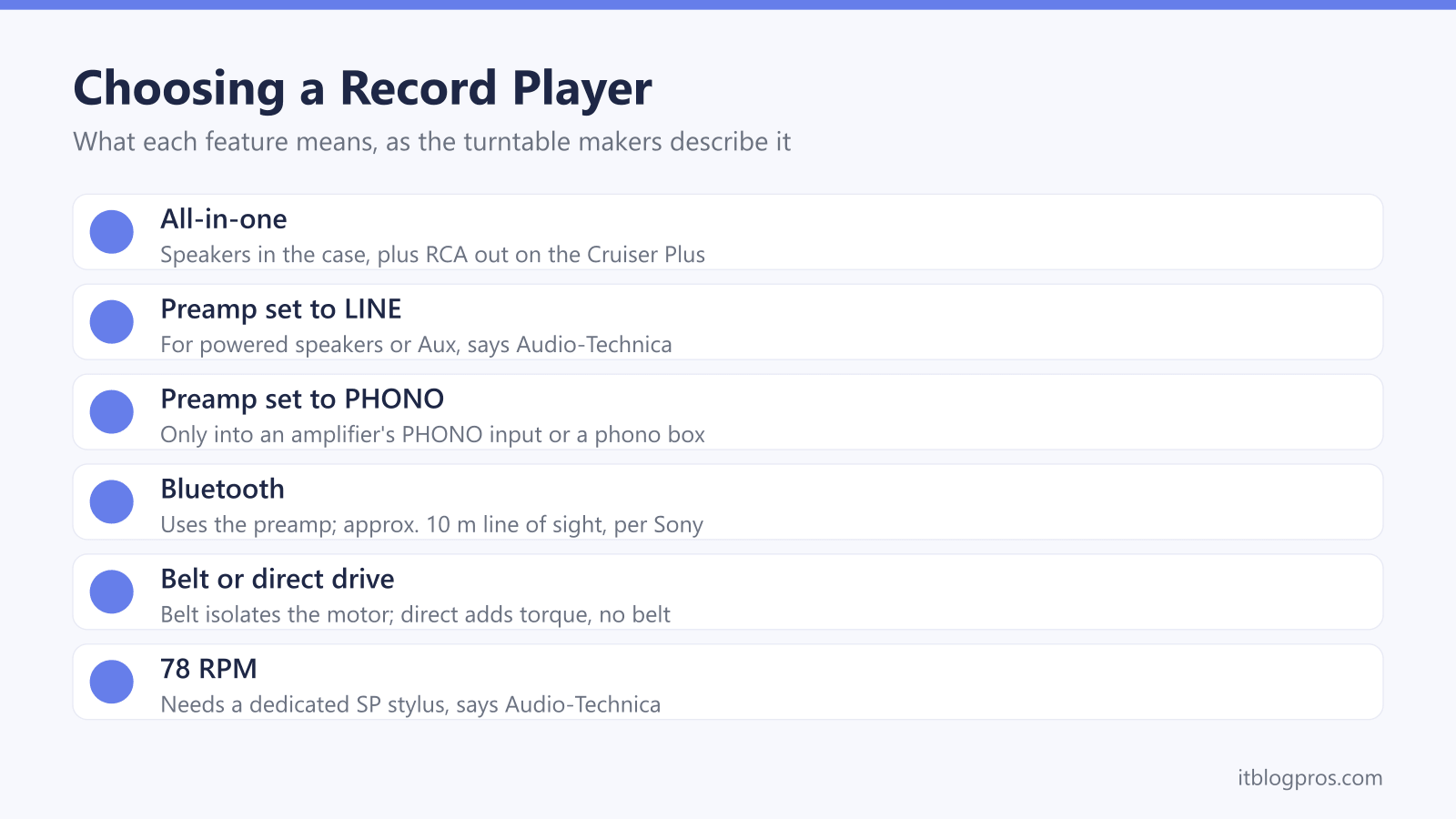
A record player can be a suitcase with the speakers built in, or a turntable that feeds powered speakers, a hi-fi or a Bluetooth speaker. The right one depends on where the phono preamp sits, which speeds the records need, the drive and how much setting up you want to do. This guide takes each choice as Audio-Technica, Sony, Pro-Ject, Crosley, Victrola, Denon and Edifier describe it, then covers set-up, record care and five products for the common jobs.
For most homes, a belt-drive turntable with a built-in switchable phono preamp, set to LINE and plugged into powered speakers, is the simplest set-up. Audio-Technica says nearly all its turntables have that preamp and that Bluetooth playback needs it switched on. A suitcase player such as the Crosley Cruiser Plus keeps the speakers in the case, and 78s need a dedicated stylus, not just a 78 setting.
Key Takeaways
- Audio-Technica explains that records are cut with RIAA equalisation, so every turntable needs an RIAA phono preamp, either built in and set to LINE or inside an amplifier's PHONO input.
- Audio-Technica warns that a LINE output plugged into an amplifier's PHONO input gives a signal that is too high, which distorts and could damage the speakers or the amplifier.
- Bluetooth turntables send sound through their built-in preamp, and Sony lists a range of approx. 10 metres in line of sight for the PS-LX3BT, with SBC, aptX and aptX Adaptive codecs.
- Audio-Technica says a belt drive keeps motor vibration away from the stylus and suits home listening, while a direct drive adds torque and has no belt to replace, usually at a higher price.
- Audio-Technica says 78s need a dedicated SP stylus, because an LP stylus damages both the record and the cartridge, even on a player that lists a 78 speed.
All-in-One Players Keep the Speakers in the Case
An all-in-one record player puts the turntable, amplifier and speakers in one box. Crosley's page for the Cruiser Plus lists three speeds, built-in full-range stereo speakers, Bluetooth in and out, an aux input, a headphone jack and an RCA output. Victrola's Journey II follows the same pattern, with a 3-speed belt-driven turntable, built-in stereo speakers and Vinyl Stream, its name for sending records to a Bluetooth speaker.
The other route is a turntable with separate speakers. Audio-Technica's connection guide explains that powered speakers have their own amplifier, their own mains connection and often a volume control, while passive speakers need a stereo amplifier between the turntable and the speakers. A separate set-up takes more room and more cables, but each part can be swapped on its own later.
The RCA output on an all-in-one keeps that door open. Crosley says it connects the Cruiser Plus to a stereo system, so the built-in speakers need not be the end of the road.
Every Turntable Needs a Phono Preamp Somewhere
A stylus produces a tiny signal that cannot go straight into a speaker. Audio-Technica explains why: since the 1950s, records have been cut with RIAA equalisation, which reduces the bass and boosts the treble so more audio fits on the disc, and an RIAA phono preamp reverses that curve on playback.
Audio-Technica says nearly all its turntables have that preamp built in, behind a PHONO/LINE switch. LINE switches it on, for powered speakers or an amplifier's Aux or CD input. PHONO bypasses it, for an amplifier with a dedicated PHONO input or a separate phono box. Mixing them up causes trouble. Audio-Technica warns that LINE into a PHONO input gives a signal that is too high, which distorts and could damage the speakers or amplifier, while PHONO into a line input sounds very quiet.
Sony's PS-LX3BT manual describes the same choice on its OUTPUT SELECT switch. Pro-Ject pitches the E1 Phono at anyone without a phono preamp, and Edifier's R990BT speakers list line inputs only, so a turntable feeding them needs its preamp on.
Bluetooth Output Trades Cables for Codecs and Range
Bluetooth turntables send the record to a wireless speaker or headphones. Audio-Technica says the built-in preamp must be in use for this, with the switch at LINE, because the receiving device is highly unlikely to have one. Sony's manual adds that the PS-LX3BT's gain switch, with Low, Mid and High settings, works only in the LINE position and applies to Bluetooth playback too.
The codec matters. Audio-Technica says aptX gives much-improved sound over standard SBC, and lists aptX Adaptive, aptX and SBC for the AT-LP60XBT, with aptX used on devices that support it. Sony lists the same three for the PS-LX3BT, with sound up to 40 kHz over aptX Adaptive at 96 kHz, against 20 kHz at 44.1 kHz. Edifier lists only SBC for the R990BT.
Range is the other limit. Sony gives approx. 10 metres in line of sight, reduced by obstacles, microwave ovens and cordless phones. For a turntable without Bluetooth, Audio-Technica suggests a third-party transmitter on the RCA outputs. The Bluetooth speaker guide and the noise-cancelling headphones guide cover the receiving end.
Belt or Direct Drive, and the Speeds Each Model Plays
Audio-Technica's support article explains the two designs. A belt drive turns the platter with a rubber belt and keeps the motor apart, so its vibration stays away from the stylus. Even a modestly priced belt drive can sound good, Audio-Technica says, and the belt eventually wears but is cheap and easy to replace. A direct drive mounts the platter on the motor, giving DJs the torque and speed stability they need with no belt to replace, though good damping can add cost.
The AT-LP60XBT, Sony PS-LX3BT, Crosley Cruiser Plus and Victrola Journey II are belt drives, and the AT-LP120XUSB is a direct drive. Speeds differ too. Audio-Technica lists 33 1/3 and 45 RPM for the AT-LP60XBT, as Sony does for the PS-LX3BT, while the AT-LP120XUSB, Denon DP-450USB, Cruiser Plus and Journey II add 78.
A 78 setting is only half the job. Audio-Technica warns never to play 78s with an LP stylus, which damages both record and cartridge, and recommends a dedicated SP stylus at around 5 grams. Crosley's and Victrola's pages list 78 without mentioning a separate stylus.
Counterweights, Tracking Force and Styli Decide the Set-Up
How much adjusting a turntable needs depends on its tonearm. Audio-Technica says entry-level models such as the AT-LP60XBT are set to fixed values, and Pro-Ject says the E1's tracking force and anti-skating are pre-adjusted at the factory. Automatic does not always mean fixed: Denon's DP-300F is fully automatic yet has adjustable balance and anti-skating controls.
For an arm with a counterweight, Audio-Technica's method is to turn the counterweight until the arm floats level, set the gauge ring to zero, then turn the whole counterweight to the cartridge's recommended force, such as 2.0 grams for the AT-VM95E fitted to the AT-LP120XUSB. Anti-skate goes to the same figure. Get it wrong, Audio-Technica warns, and the result can be distortion or sound from only one channel.
Styli are replaceable. The AT-LP60XBT takes the conical ATN3600LC or the elliptical ATN3600LE, which Audio-Technica says sits lower in the groove and picks up less surface noise. The AT-VM95E accepts any VM95 series stylus, while Sony says not to fit another company's stylus to the PS-LX3BT.
USB Output Digitises Records, and a Level Surface Protects Them
To copy records to a computer, look for USB. Audio-Technica says the AT-LP120XUSB connects straight to a Mac or PC and suggests the free Audacity software, and its spec lists 16-bit recording at 44.1 or 48 kHz. Denon says the DP-450USB records through its USB output to MP3 or WAV files. Sony's spec page lists no USB connector on the PS-LX3BT, and Audio-Technica points to the AT-LP60XUSB, not the Bluetooth model, for digitising.
Placement comes next, and it is where a record player stand earns its place. Sony and Victrola both ask for a stable, level surface, and Victrola says a slanted one can make the player skip. Sony also says not to install the PS-LX3BT in a confined space such as a bookcase or built-in cabinet.
For the records, Victrola recommends brushing them before play, holding them by the edges and label, and storing them upright in paper inner sleeves somewhere cool and dry. Audio-Technica says to brush a stylus from the back of the cartridge to the front, never side to side.
Four Turntables and a Pair of Speakers Cover the Common Set-Ups
First, the caveats. Edifier lists only line inputs on the R990BT, so the turntable's preamp must be set to LINE, and SBC is its only Bluetooth codec. The AT-LP60XBT and Sony PS-LX3BT play 33 1/3 and 45 only, and neither has a USB connector. The Crosley Cruiser Plus lists 78, but Audio-Technica's advice on SP styli still applies to old shellac records.
With that settled, the table covers the usual jobs. The AT-LP60XBT is the all-round pick: fully automatic and belt-driven, with a switchable preamp, an RCA cable and aptX Bluetooth. The Crosley Cruiser Plus is the budget all-in-one, with stereo speakers, Bluetooth in and out and an RCA output for later. Sony's PS-LX3BT is the one-button Bluetooth choice, with aptX Adaptive and three gain settings. The AT-LP120XUSB suits digitising and 78s, with USB, a direct drive and VM95 series styli. Edifier's R990BT speakers take two RCA line sources plus Bluetooth, so a turntable and a second device can share them.
| Product | Best for | Key specs | Price | |
|---|---|---|---|---|
 | Audio-Technica AT-LP60XBT Our pick | A first turntable for Bluetooth or powered speakers | Automatic belt drive, 33/45, switchable preamp, aptX | Check price → |
 | Crosley Cruiser Plus Budget | An all-in-one player with built-in speakers | 3 speeds, stereo speakers, Bluetooth in and out, RCA out | Check price → |
 | Sony PS-LX3BT Bluetooth | One-button play to aptX Adaptive speakers | Automatic belt drive, 33/45, preamp, 3 gain settings | Check price → |
 | Audio-Technica AT-LP120XUSB USB and 78s | Digitising records and playing 78s with an SP stylus | Direct drive, 33/45/78, USB output, switchable preamp | Check price → |
 | Edifier R990BT (pair) Speakers | Powered speakers for a turntable set to LINE | 12 W + 12 W, two RCA line inputs, Bluetooth 5.4, SBC | Check price → |