
A dehumidifier pulls water out of the air and into a tank, which is how it keeps condensation off windows and walls. Choosing one for a UK home comes down to a handful of decisions: compressor or desiccant, how many litres a day at realistic conditions, where the water goes, and what humidity to aim for. This guide takes each in turn as Meaco, Ebac, Pro Breeze and EcoAir explain it, alongside GOV.UK's damp and mould guidance, then covers four models that suit common homes.
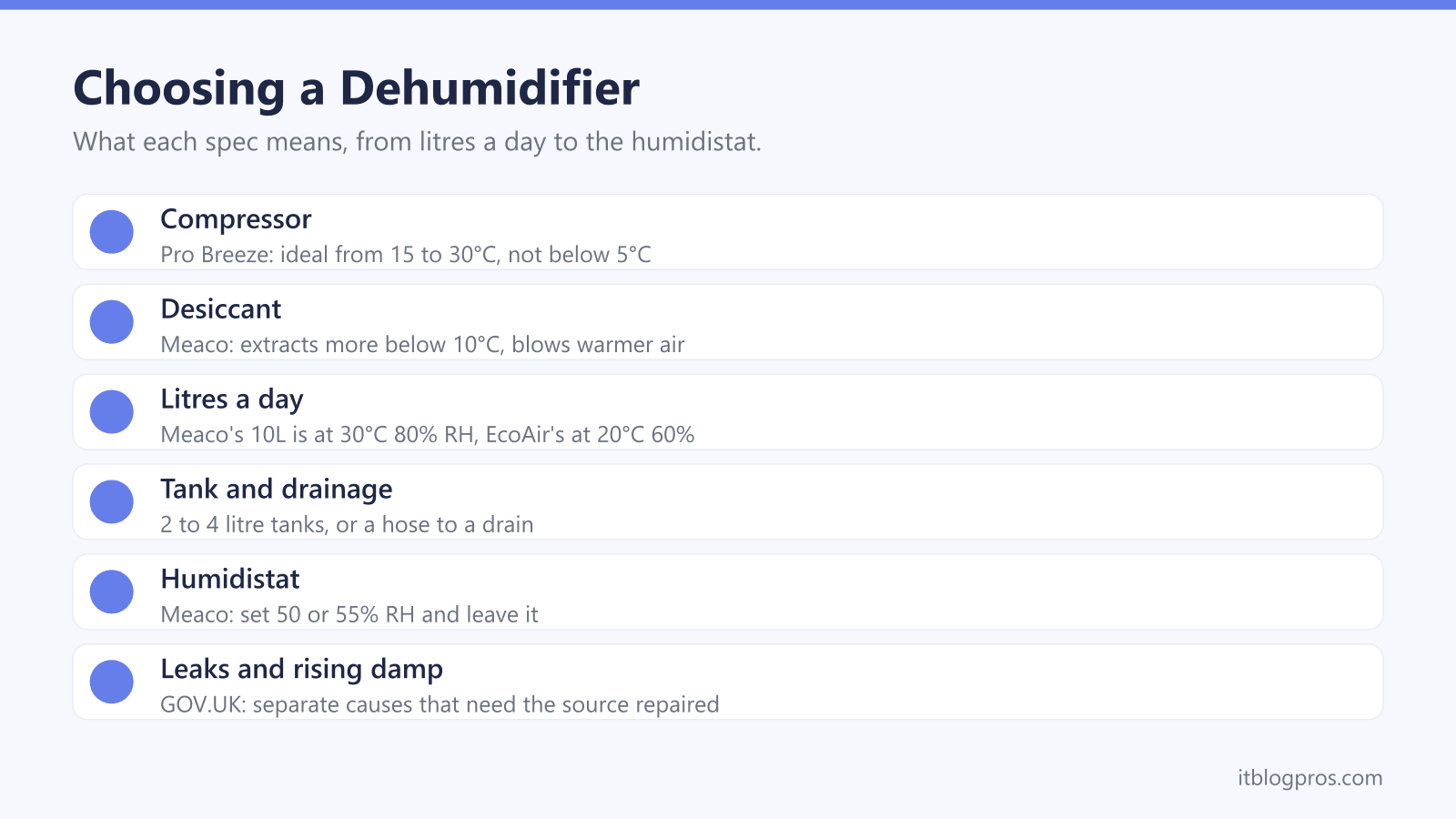
For a heated UK home, Ebac and Pro Breeze point to a compressor dehumidifier, and for a room that drops below 10°C, Meaco says a desiccant extracts more. Compare litres a day only at the same test conditions, since Meaco measures the 10 litre figure for its 10L models at 30°C and 80% RH. A dehumidifier treats condensation, and GOV.UK treats leaks and rising damp as separate problems that need a repair.
Key Takeaways
- GOV.UK's damp and mould guidance separates condensation from penetrating, rising and traumatic damp, and says landlords are legally responsible for addressing damp and mould whatever the type.
- Meaco says desiccant dehumidifiers extract better than compressors below 10°C, while Ebac says a desiccant needs 650 watts against 150 for a compressor doing the same task.
- Meaco rates the Arete Two 10L at 10 litres a day at 30°C and 80% RH, but its own table shows 4.19 litres at 20°C and 60% RH, so litres a day only compare at the same test conditions.
- Meaco's managing director says to set the humidistat to 50 or 55% RH and leave it, while Pro Breeze's own pages disagree with each other on the ideal range.
- Meaco says scheduling a dehumidifier with a smart plug forces a power cut that shortens its life and invalidates the warranty, so setting the humidistat and leaving it to run is the safer route.
A Dehumidifier Treats Condensation, Not Leaks or Rising Damp
GOV.UK's guidance on the health risks of damp and mould describes four kinds of damp. Condensation damp, which it calls the most common form, happens when moisture made inside the home cools and settles on colder surfaces such as window frames and the wall behind a wardrobe. Showering, cooking and drying laundry all add to it, the guidance says, and that airborne moisture is what a dehumidifier removes.
The other three need a repair. Penetrating damp gets in through defects in walls, roofs, windows or floors. Rising damp moves up from the ground and, according to GOV.UK, is often misdiagnosed, while traumatic damp comes from leaking or burst pipes and overflowing baths. For renters, the guidance says landlords are legally responsible for addressing damp and mould whatever the type, and calls blaming it on lifestyle choices totally unreasonable. Warmth matters as well: GOV.UK notes that energy-efficient homes are easier to heat and typically less prone to damp, which the smart thermostat guide picks up. The guidance applies to England.
Compressors Suit Heated Rooms and Desiccants Suit Cold Ones
Meaco describes a compressor dehumidifier drawing room air over cold coils, so the water condenses and drips into a bucket. A desiccant has no cooling coils: Meaco says an absorbent wheel soaks up moisture like a sponge and a heater dries it, so the air leaving a desiccant is about 10 to 12°C warmer. Both Meaco and Pro Breeze say desiccants tend to be quieter, and Meaco puts that down to no compressor kicking in.
Temperature decides between them. Meaco says desiccants extract better than compressors below 10°C, which suits an unheated room or conservatory, though its Arete compressors work from 5°C. Pro Breeze's buying guide gives compressors an ideal range of 15 to 30°C and says they will not work below 5°C.
The makers disagree on homes. Ebac, which builds compressors, says a desiccant needs 650 watts against 150 for a compressor doing the same task, and suits garages and outbuildings rather than the home. Mini Peltier units are a third type: Pro Breeze pitches them at wardrobes and cupboards, and Meaco says not to use them below 15°C.
Litres a Day Only Compare at the Same Test Conditions
Extraction rate is the water a dehumidifier removes in 24 hours, and the figure depends on the air it was measured in. Meaco states its conditions: the Arete Two 10L removes 10 litres a day at 30°C and 80% relative humidity (RH), or 6 litres at 27°C and 60% RH. Meaco's own table shows 4.19 litres at 20°C and 60% RH, and 1.38 litres at 10°C and 60% RH. EcoAir rates its DD1 Simple MK3 desiccant at 7.5 litres a day at 20°C and 60% RH, a much cooler test, while Pro Breeze's page for the OmniDry 20L gives 20 litres a day with no test conditions.
Ebac's extraction rates page says the figures quoted by all manufacturers can be misleading because they refer to conditions not found in the UK, and that 95% of UK homes need to remove a maximum of 2 litres a day. Ebac's desiccant advice recommends a compressor with an average extraction rate of around 18 litres for a home, or 12 to 15 litres for a very small home with one occupant.
Room Size, Tank and Drainage Decide How Often You Empty It
Each maker sizes rooms its own way, so the floor area on a box is a rough guide. Meaco rates both the ABC 10L and the Arete Two 10L for homes of up to 2 bedrooms, Pro Breeze rates the OmniDry 20L for up to 30m², and EcoAir says the DD1 Simple MK3 covers areas up to 60m². Pro Breeze's buying guide sizes by dampness as well as floor area and recommends buying the largest dehumidifier you can for the space. For a whole floor, Meaco suggests leaving the internal doors open, since the dry air reaches as far as the fan can push it.
The tank sets how often you empty it. Meaco lists 2.5 litres for the Arete Two 10L and 2.6 litres for the ABC 10L, EcoAir lists 2 litres, and Pro Breeze lists 4 litres for the OmniDry 20L. Continuous drainage runs a hose to a drain instead: Meaco offers it on both 10L models with the hose not included, Pro Breeze includes two 100cm hoses, and Ebac says all its dehumidifiers offer permanent drainage.
Laundry Mode Speeds Up Drying Clothes Indoors
Drying washing indoors is one of the everyday sources of moisture GOV.UK lists, and it is the job many dehumidifiers are bought for. Ebac's FAQ says it takes on average around 8 hours to dry laundry with a dehumidifier. A laundry mode shortens that by working harder: Pro Breeze says its mode uses a higher fan speed and maximum dehumidification, and Meaco says the Arete Two adds an extra fan speed for laundry along with adjustable laundry timers.
Size counts too, though Meaco's pages pull in different directions. Its Q&A page says a 20 or 25 litre dehumidifier will dry laundry fastest, yet its Arete Two page claims that 10L model dries laundry faster and more cheaply than any other Meaco dehumidifier.
Desiccants have a case here too. Meaco says they often dry laundry better than compressors because low temperatures do not affect them and their warm air helps, and EcoAir lists a laundry mode on the DD1 Simple MK3, saying its slightly warm air helps clothes dry.
Set the Humidistat and Let the Dehumidifier Decide When to Run
Meaco compares a humidistat to a thermostat: it lets the dehumidifier turn off and on as required. Meaco's managing director, Chris Michael, says to set it to 50 or 55% RH and then leave it. Meaco adds that mould occurs around 68% humidity. The Arete Two's humidistat runs from 40% to 70% RH, and the ABC 10L's from 30% to 80%.
Pro Breeze contradicts itself on the target. Its buying guide calls 30 to 50% ideal in summer and 30 to 40% in winter, while its 20L Max Extraction page puts optimal comfort between 40% and 60%. Ebac says its Smart Control removes excess moisture rather than working to a specific RH. GOV.UK lists consistently high relative humidity among the signs of damp but sets no target figure.
Letting the humidistat decide also rules out a smart plug. Meaco says scheduling a dehumidifier that way forces a power cut that stops its shutdown processes, shortens its life and invalidates the warranty. Smart plugs are better kept for lamps, and the smart plug WiFi guide covers setting one up.
Four Dehumidifiers Cover Family Homes, Cold Rooms and Flats
None of these will cure a leak, penetrating damp or rising damp, which GOV.UK treats as repairs, and in a rented home that repair is the landlord's to address. The Pro Breeze OmniDry 20L suits a busy household: a 4 litre tank, a laundry mode, 36dB and the Pro Breeze app with Alexa and Google Home, which pairs with an Echo speaker. Pro Breeze rates it for up to 30m², not a whole house, and gives 0.27kWh rather than a wattage.
For a room below 10°C, the EcoAir DD1 Simple MK3 desiccant works from 1°C, EcoAir says, at 300 watts on low and 580 on high, and 34dB(A) to 47dB(A). The Meaco Arete Two 10L suits a flat or bedroom, from 35dB at 152 watts, with the Meaco app, Alexa and Google voice control and an H13 HEPA filter. The NHS's aspergillosis page suggests people with a lung condition or weakened immune system consider a dehumidifier and a HEPA air purifier at home. The Meaco ABC 10L is the simpler Meaco, from 36dB at 165 watts, with no app.
| Product | Best for | Key specs | Price | |
|---|---|---|---|---|
 | Pro Breeze OmniDry 20L Smart Dehumidifier Family home | A busy household with lots of washing and app control | Compressor, 20L a day, 4L tank, 36dB, laundry mode | Check price → |
 | EcoAir DD1 Simple MK3 Desiccant Dehumidifier Cold rooms | An unheated room or winter drying, working from 1°C | Desiccant, 7.5L a day at 20°C 60% RH, 300W/580W, 2L tank | Check price → |
 | MeacoDry Arete Two 10L Dehumidifier Smart and quiet | A flat or bedroom, with app control and a HEPA filter | Compressor, 10L a day at 30°C 80% RH, from 35dB, 152W | Check price → |
 | MeacoDry ABC 10L Dehumidifier Budget | A small home of up to 2 bedrooms, without the app | Compressor, 10L a day at 30°C 80% RH, 165W, 2.6L tank | Check price → |