An item tracker is a small Bluetooth tag that clips to your keys or slips into a wallet, then shows up on a map when the item goes missing. The catch is that each one leans on a phone maker's finding network, so the wrong tag for your phone is just a keyring. This guide sets out what Apple, Samsung, Google, Tile and Chipolo say about compatibility, finding networks, precision finding, batteries, water ratings and unwanted-tracking alerts, then matches five trackers to the phone.
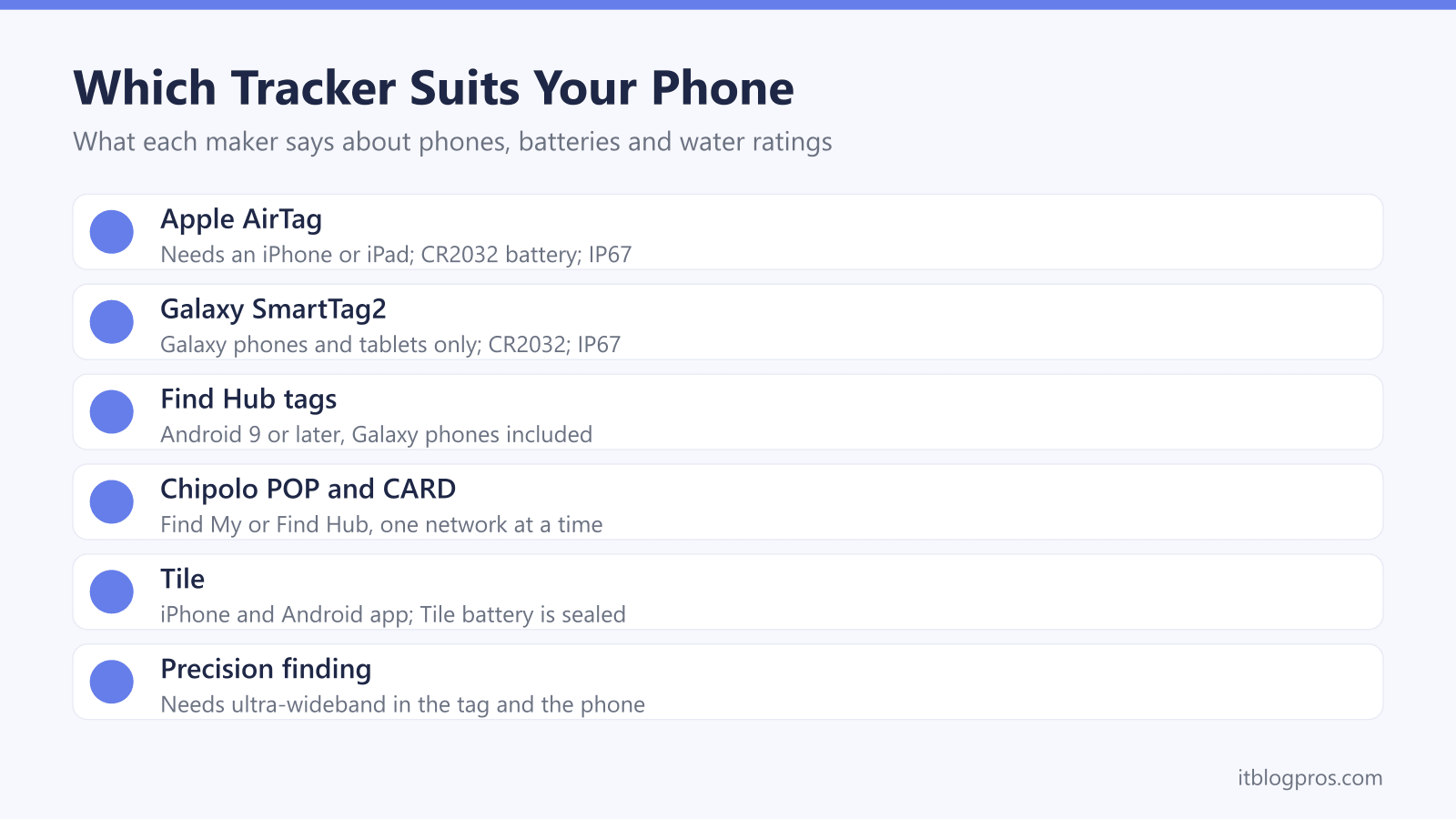
Pick the tracker that matches your phone. Apple's AirTag needs an iPhone or iPad, and Samsung's Galaxy SmartTag2 needs a Galaxy phone or tablet. Android phones, Galaxy models included, can use Find Hub tags such as Motorola's moto tag. Chipolo's POP and CARD work with Apple Find My or Google's Find Hub, one network at a time, and Tile works through its own app on iPhone and Android.
Key Takeaways
- Apple's AirTag spec asks for an iPhone or iPad with an Apple Account, and Samsung's UK page limits the Galaxy SmartTag2 to Galaxy phones and tablets.
- Chipolo says its POP and CARD work with Apple Find My or Google's Find Hub, but only one network at a time.
- Precision finding needs ultra-wideband in the tag and the phone, and Apple ties the longer range of the AirTag (2nd generation) to iPhone 15 or later or iPhone Air.
- AirTag, Galaxy SmartTag2 and Chipolo POP take a CR2032 coin cell, while Tile rates the sealed battery in its standard Tile at three years.
- Apple says AirTag should not be used to track people, and Google's Find Hub help says tracker tags should not be used to track pets.
The Phone in Your Pocket Decides Which Tracker Works
Every tracker here pairs with a phone, and most pair with only one kind. Apple's AirTag spec list asks for an Apple Account and an iPhone on iOS 26.2.1 or later, or an iPad on iPadOS 26.1 or later, and names no Android option. Samsung's UK page limits the Galaxy SmartTag2 to Galaxy phones and tablets on Android 9 or higher, though Samsung's UK launch announcement said Android 11 or higher, so Samsung contradicts itself.
Other Android phones, and Galaxy models too, can use Google's Find Hub. Google's compatible devices page lists Motorola's moto tag and Chipolo's POP, LOOP and CARD, and Motorola's UK page says the moto tag needs an Android 9.0 phone or later. Chipolo says its POP and CARD work with Find My or Find Hub, one at a time, and switching means removing the tracker from one app first. Tile says its trackers work with most iOS and Android devices. The guides to which iPhone to buy, which Samsung phone to buy and which Pixel to buy cover the phone side.
Each Finding Network Runs on Other People's Phones
The makers describe the same basic idea: the tag sends out a Bluetooth signal, and passing phones report where they heard it. Apple's AirTag page says nearby devices in the Find My network send the AirTag's location to iCloud, anonymously and encrypted, and puts that network at more than a billion iPhone, iPad and Mac devices.
Google calls Find Hub, previously Find My Device, a crowdsourced network of Android devices with end-to-end encrypted locations. It adds that your phone needs a PIN, pattern or password before the network will help find your items. In the busy-places setting, Google says the network waits until several Android devices have detected a lost item before showing its location.
Samsung's UK newsroom describes SmartThings Find working the same way among Galaxy devices that opt in. Tile says marking an item as lost in its app lets its network of millions of devices update the location. For a tag in a suitcase or laptop bag, Apple says Find My can share its location with more than 50 airlines, British Airways and Virgin Atlantic among them.
Precision Finding Needs Ultra-Wideband in the Tag and the Phone
The map gets you to the right room. Ultra-wideband, which Google describes as distance and directional guidance, gets you to the right sofa cushion. Apple says the AirTag (2nd generation) has a second-generation Ultra Wideband chip and up to 1.5 times the Precision Finding range of the first model, but only with iPhone Air or iPhone 15 or later, excluding iPhone 16e. Apple's tech specs for the first AirTag list Precision Finding on iPhone 11 to iPhone 15 models, and on the wrist it needs an Apple Watch Series 9, Ultra 2 or later.
Samsung's Compass View, which points arrows towards a SmartTag2, needs a UWB-enabled Galaxy phone on Android 11 or higher. For Find Hub tags, Google says the tag and phone must both support UWB, on Android 13 and up, and names Pixel 8 Pro and later Pro models, Galaxy S21+ and Ultra models onwards, and Motorola Edge and Razr phones. Motorola says the moto tag's UWB needs a supported Android phone. Chipolo's and Tile's spec pages list no UWB, so those tags are found by ringing them.
Most Tags Take a CR2032 Coin Cell, but Not All of Them
Apple, Samsung and Chipolo all use a CR2032, the flat 3V lithium coin cell that Apple says is sold at most electronics shops and pharmacies. Apple says the AirTag runs for more than a year on one, and its support page explains the swap: press down on the stainless steel cover, turn it anticlockwise, fit the new cell positive side up and listen for the sound. Apple also warns that some bitterant-coated cells might not work, and suggests packs marked as compatible with Apple AirTag.
Samsung's UK page lists a replaceable CR2032 for the Galaxy SmartTag2, with up to 500 days of battery life and a tray eject pin in the box. Chipolo's POP takes a CR2032 too, supplied as a bitter-coated Duracell, while the Chipolo CARD charges on a Qi wireless charger, not included, and lasts up to a year per charge. Motorola rates the moto tag at a year with easy-to-replace batteries. Tile goes the other way: its standard Tile and Tile Slim have non-replaceable batteries rated at three years, while the Tile Pro's battery is replaceable.
Water Ratings Cover Rain and Puddles, Not Swimming
Each maker quotes an IP rating, which Apple's spec ties to the IEC 60529 standard, and most add their own limits. Apple rates the AirTag IP67, for a maximum depth of 1 metre for up to 30 minutes, and says resistance is not permanent and might decrease with normal wear. Samsung gives the Galaxy SmartTag2 the same IP67 rating in fresh water, but says it is not advised for the beach, the pool or soapy water.
Tile rates its Tile and Tile Slim at IP68, describing that as surviving minor splashes and a 1.5 metre plunge, and says neither is meant for underwater use. Chipolo splits its range: the CARD is IP67, for up to 30 minutes in 1 metre of water, while the POP is IP55, protected from dust and splashes. Motorola's UK page is muddled, giving the moto tag an IPX8 rating for 1.5 metres of fresh water for 30 minutes in a footnote that also says it is not waterproof or dust proof.
Unwanted Tracking Alerts Now Work Across iPhone and Android
Trackers can be misused, so both phone systems now watch for them. Apple says it and Google created an industry specification so that iOS and Android can warn people when an unknown tracker is moving with them. On an iPhone, Apple says alerts for these compatible trackers need iOS 17.5 or later, with Bluetooth, Location Services and Tracking Notifications switched on. Apple adds that an AirTag long separated from its owner plays a sound when moved.
On Android 6 and up, Google's help page says Unknown tracker alerts cover Find Hub tags, headphones and Apple AirTags, and a manual scan under Settings, Safety and emergency, Unknown tracker alerts takes about 10 seconds. Chipolo says its Find Hub models support these protections on Android 6 and iOS 17.5 or later. Samsung's UK newsroom describes Unknown tag alerts in SmartThings Find for Galaxy users. Tile runs its own Scan and Secure in the Tile app, which Tile says cannot see Tiles in Anti-Theft Mode or other makers' trackers. Apple and Google both advise contacting the police if you feel unsafe.
Five Trackers Matched to iPhone, Android and Wallets
Two caveats come first. Apple says AirTag and Find My accessories should not be used to track people, and that tracking someone without consent is a crime in many countries, while Tile says it prohibits tracking any individual without their knowledge or consent. On pets the makers disagree: Google's Find Hub help says tracker tags should not be used to track pets or locate stolen items, while Samsung's UK launch announcement suggested a SmartTag2 on a pet's collar so a finder can read your contact details in Lost Mode.
With that settled, the table follows the phone. The AirTag (2nd generation) is the iPhone pick, with longer-range Precision Finding on iPhone 15 or later. Motorola's moto tag is the Android pick on Find Hub, with UWB on supported phones, and Galaxy owners can also choose Samsung's own SmartTag2. The Chipolo POP suits keys for anyone who might change phones, since it works with either network. The Chipolo CARD fits a wallet and recharges wirelessly, and the Tile is the budget choice, with one app on iPhone and Android.
| Product | Best for | Key specs | Price | |
|---|---|---|---|---|
 | Apple AirTag (2nd generation) iPhone | iPhone owners who want Precision Finding | CR2032, IP67, second-gen UWB chip, needs iPhone or iPad | Check price → |
 | Motorola moto tag Android | Pixel, Galaxy and other Android phones on Find Hub | Find Hub, UWB, 1-year replaceable battery, Android 9+ | Check price → |
 | Chipolo POP Either phone | Keys for anyone who might switch phones | Find My or Find Hub, CR2032, IP55, up to 90 m range | Check price → |
 | Chipolo CARD Wallet | Wallets and passports, on iPhone or Android | Qi rechargeable, IP67, 2.5 mm thick, up to 120 m range | Check price → |
 | Tile (Life360) Budget | One tracker app on both iPhone and Android | Sealed 3-year battery, IP68, up to 106 m range | Check price → |