
A thermostatic radiator valve, the numbered dial at the end of most UK radiators, sets how warm one room gets. A smart radiator valve swaps that dial for a motorised head you can schedule from an app, so the spare room stays cool while the lounge warms up. Picking one comes down to four checks: how it links to your thermostat, which hub it needs, whether it fits your valve body, and who fits it. Here is how tado, Hive, Drayton Wiser, Netatmo and Honeywell describe their own valves.
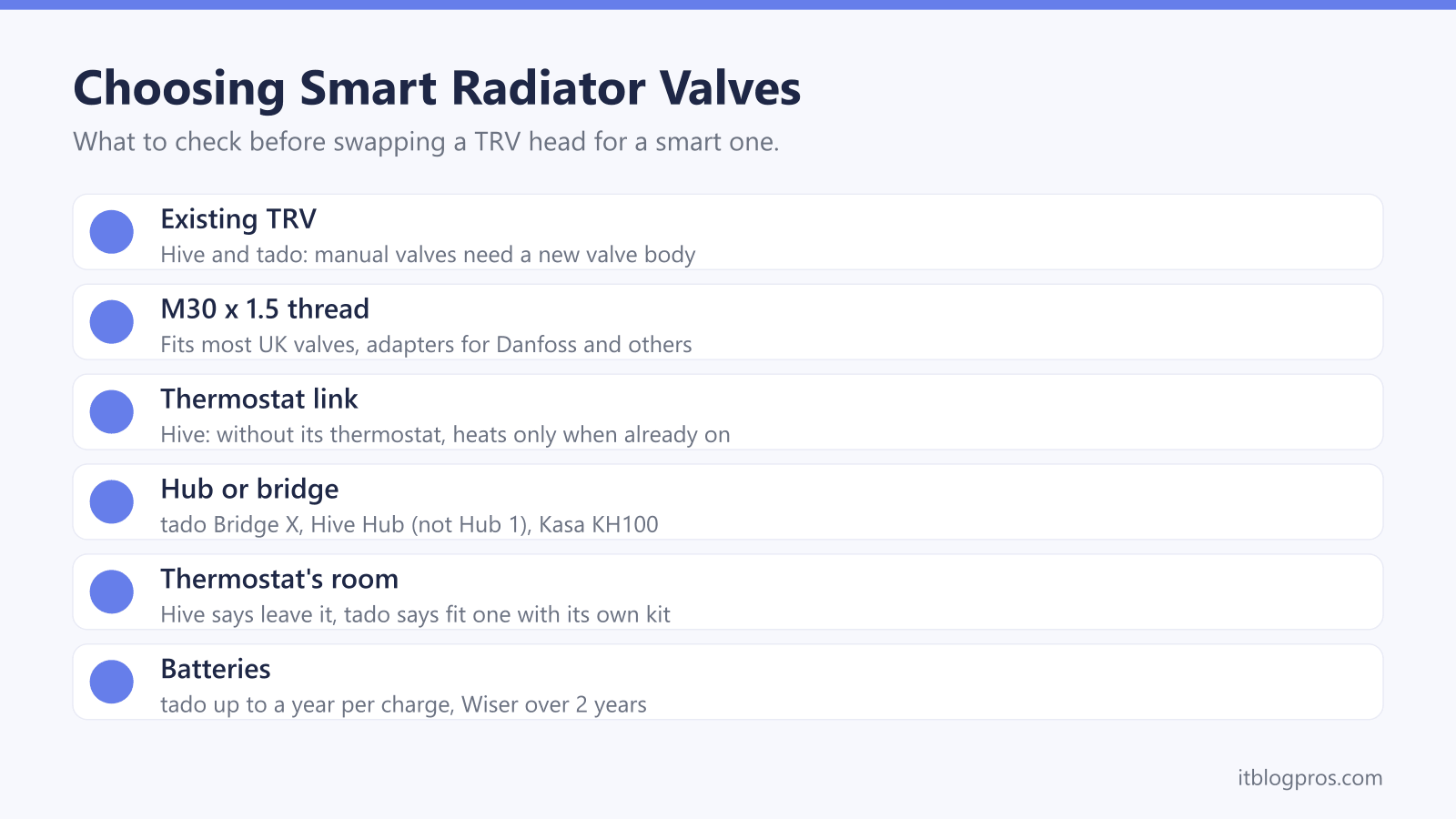
A smart radiator valve screws onto an existing thermostatic valve body, and the common M30 x 1.5 thread takes most of them directly, with adapters for Danfoss and other types. Hive and tado both say a manual on and off valve has to be replaced first. Each brand needs its own hub or bridge, and the valves only switch the boiler on when linked to that brand's thermostat or boiler controller.
Key Takeaways
- The Energy Saving Trust says a TRV senses the air around it to control hot water flow through one radiator, and that dial numbers mean different temperatures on different models.
- Hive says its Radiator Valves work without a Hive thermostat but then only warm a room while the heating is already on, and tado says rooms without its valves heat whenever the boiler runs.
- Hive advises against fitting its valves in the same room as the main thermostat, while tado recommends one in the room where its own thermostat sits, so follow the maker of your thermostat.
- tado, Hive, Drayton Wiser and Honeywell all fit the common M30 x 1.5 valve thread, and each lists the Danfoss and other adapters it supplies for the rest.
- Hive and tado treat swapping an existing TRV head as a DIY job, but both say a manual valve needs a new valve body first, and tado recommends a professional for that.
A Thermostatic Radiator Valve Controls One Radiator, Not the Boiler
The Energy Saving Trust (EST) describes a thermostatic radiator valve, or TRV, as a way to control the temperature in an individual room. The valve senses the air around it and adjusts how much hot water flows through its radiator: less as the room warms up, more as it cools. Most have a numbered dial, and the EST points out that the numbers do not match the same temperature on every model, so it suggests starting in the middle and finding the lowest setting that keeps the room comfortable.
A TRV never switches the boiler on. The EST's heating controls guide says a boiler system should have at least a programmer for timing, at least one room thermostat and TRVs, each doing its own job. The same guide adds two practical warnings. Radiator covers can trap warm air around the valve so it shuts off too soon, and rooms used less often are better kept at a lower background temperature than left completely unheated, which helps reduce the risk of condensation and mould.
Smart Valves Call for Heat Only When Linked to a Thermostat
The EST describes programmable TRVs as valves with their own timing, and says some connect to smart heating controls so that each room becomes a zone. That link to the thermostat decides how much a smart valve can do.
Hive's product FAQ spells it out. Its Radiator Valves need only a Hive Hub and the Hive app, but without Hive Active Heating they can only control a radiator while the heating is already on, and cannot override the existing thermostat. Pair them with a Hive thermostat and a feature Hive calls Heat on Demand lets a valve turn the heating on when its room needs warmth. Hive's own blog warns that this is not really designed for one smart valve among lots of manual ones, since the boiler then warms more of the house than intended.
tado describes the same pattern. When tado also runs the boiler, its valves sync with the central thermostat so each room can request heat, and tado suggests setting any ordinary TRVs to frost protection. The thermostat itself is covered in the smart thermostat guide.
The Makers Disagree About the Radiator in the Thermostat's Room
Where the main thermostat sits, the advice splits. Hive's guide to its Radiator Valves recommends not fitting them to any radiator in the same room as a main thermostat, because a thermostat set higher than the valve can leave the heating permanently on. tado takes the opposite line for its own kit: its help centre recommends a Smart Radiator Thermostat in the room that holds the tado thermostat or temperature sensor, which then measures the temperature for that valve.
Both make sense inside their own systems, so the safest rule is to follow the maker of the thermostat you have. For the thermostat's position, the EST says a room thermostat needs a free flow of air and should be kept away from heat sources such as radiators.
Putting smart valves on every radiator raises one more point. tado's help centre says that in very few cases a heating system without a bypass may need a bypass valve, a differential pressure regulator that keeps pump pressure and flow steady, and it recommends a professional plumber for that job.
Each Brand Needs Its Own Hub, Bridge or Controller
No two of these brands share a hub, so the first valve decides the rest of the system. tado's Smart Radiator Thermostat X needs a Bridge X or another Thread border router, and tado says its older V3+ Internet Bridge does not work with the X range. Hive's valves need the current Hive Hub or Hub 360, not the original Hub 1. Drayton says its Wiser Radiator Thermostat (2nd Generation) works with every Wiser hub, and lists open-window detection that can reduce heating automatically.
Netatmo's UK shop sells its valves as an accessory for its Smart Indoor Thermostat or valve starter pack, with schedules and open window detection. Honeywell Home's HR92UK, listed by Resideo, works with evohome to control up to 12 radiators and zones, and closes the valve for a set time when an open window drops the temperature. TP-Link says the Kasa KE100 needs the KH100 hub, which only joins 2.4GHz WiFi.
For voice control, tado, Hive, Drayton and TP-Link all list Amazon Alexa and Google Assistant, so an Echo speaker can set a room's temperature.
M30 x 1.5 Fits Most Valves and Adapters Cover the Rest
A smart head screws onto the valve body, the brass part that stays on the radiator pipe, and the thread sizes vary. Drayton's Wiser adapter guide says the most common thermostatic valves, including Drayton, Honeywell, Pegler, Myson and Siemens, have an M30 x 1.5 connection, and that its two included adapters, M30 and Danfoss RA, cover approximately 95% of UK TRVs.
tado's help centre says its screw nut fits any M30 x 1.5 body directly, and lists adapters in the box for Danfoss RA, RAV and RAVL, M28 x 1.5, Caleffi and Giacomini valves. It provides none for Vaillant, Oventrop M30 x 1.0, Ista or Orkli M28 x 1.0. Hive packs M30, M28 and Danfoss RA adaptors and supplies Giacomini and Caleffi ones through its support team, but has no adaptor for M28 x 1.0 bodies sold under Orkli, Concerto or Wessex. Resideo's HR92 manual lists an M30 x 1.5 baseplate and a Danfoss RA adapter in the box. TP-Link contradicts itself: the KE100 KIT page lists six adapters, while its FAQ lists three.
Swapping the Head Is DIY, but a New Valve Body Needs a Plumber
If the radiator already has a TRV with a numbered dial, fitting is a head swap. Hive says its valve can be self-installed by unscrewing the old head, with the app guiding the job in around 10 to 20 minutes, and its blog says there is no need to drain the radiator. Resideo says the HR92 mounts on M30 x 1.5 valves without draining the system, and tado says its app-guided fitting carries no risk of water leaks.
A manual valve changes things. tado says its valves do not work with on and off valves, and recommends asking a professional to swap one for an M30 x 1.5 thermostatic valve. Hive says manual plus and minus valves need a new valve body first, and that a leaking valve body should be fixed before fitting. Drayton sells a 15mm valve body for this job, and its page recommends a qualified installer. tado also rules out monotube (single pipe) systems and flow temperatures of 85°C or more, and Hive says its valves do not work with electric radiators.
Four Smart Radiator Valves Cover the Common Starting Points
None of these will run a boiler on their own. Hive and tado valves need the brand's thermostat to call for heat, and TP-Link's KE100 pages describe valve and hub control only. The tado Smart Radiator Thermostat X Starter Kit includes a Bridge X, and tado says the USB-C rechargeable battery lasts up to a year, while its radiators page claims 12+ months. Single tado valves then add rooms. tado's open window detection sends an alert, and only switches the heating off automatically with its AI Assist subscription.
The Hive Radiator Valve suits a home already on Hive. It takes two AA alkaline batteries, Hive's page gives no battery life, and its window feature pairs with Hive Window Sensors. TP-Link's Kasa KE100 KIT is the budget route, hub included, with batteries TP-Link says generally last over a year and window detection only through a Tapo T110 sensor.
On savings, tado says users save 22% on average, from internal data to November 2023. The EST says whether smart controls save money depends on how you control your heating now.
| Product | Best for | Key specs | Price | |
|---|---|---|---|---|
 | tado Smart Radiator Thermostat X Starter Kit with Bridge X Our pick | Starting room-by-room control with tado's own bridge | Bridge X, M30 x 1.5 nut, USB-C rechargeable battery | Check price → |
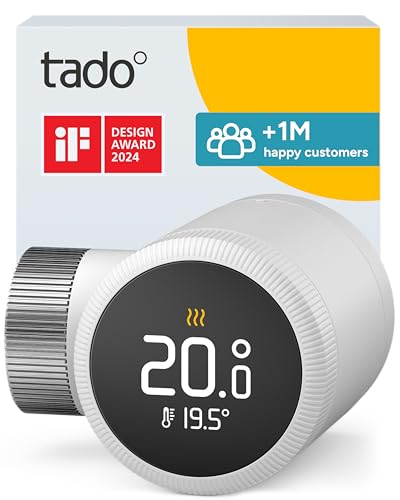 | tado Smart Radiator Thermostat X tado add-on | Adding rooms to a tado X system or Thread network | Six adapters per pack, needs Bridge X or Thread router | Check price → |
 | Hive Radiator Valve Hive homes | Homes with a Hive Hub, ideally with a Hive thermostat | 2 x AA, M30, M28 and Danfoss RA adaptors, Zigbee | Check price → |
 | TP-Link Kasa KE100 KIT Smart Thermostatic Radiator Valve Starter Kit Budget | Valve-only room control, hub included, no boiler link | KH100 hub, 2 x AA, M30 x 1.5, up to 32 valves per hub | Check price → |