Ring Automotive's car battery guide calls a battery fault the most common reason for cars to break down in the UK, particularly in winter. A lithium jump starter in the boot means a flat battery no longer needs a second car and a set of jump leads. This guide sizes a pack by engine size and fuel type, explains the peak amp figure on the box, and sets out what NOCO and Ring say about safety, storage and cold. Cordless tyre inflators and combined units follow, then five picks.
Match the pack to the engine and fuel, not the amps: NOCO rates its 1,000A GB40 for petrol engines up to 6.0 litres but diesels only up to 3.0 litres, and its 2,000A GB70 for diesels up to 6.0 litres. Look for reverse polarity and spark protection, recharge the pack every four to six months as NOCO advises, and set any tyre inflator to the pressure in the handbook or on the door sticker.
Key Takeaways
- NOCO sizes its Boost packs by engine and fuel: the GB40 covers petrol engines up to 6.0 litres and diesels up to 3.0 litres, the GB70 diesels up to 6.0 litres.
- Peak amps are a split-second figure: Ring's user guide rates its 1500A ULTRABOOST at 1,500A for 0.1 seconds and 350A for three seconds.
- NOCO advises recharging a stored pack at least every four to six months, and says its packs work from -20°C to 50°C but should only be recharged between 0°C and 40°C.
- Set a cordless inflator to the car's own figure: the AA says the handbook lists it, with a sticker usually on the driver's door edge or inside the fuel filler flap.
- The AA says that if jump starting does not work the car needs a new battery, and that most batteries last somewhere between five and seven years.
Engine Size and Fuel Type Decide the Pack
Every maker sizes its packs by engine, so start with the car rather than the box. NOCO's Boost FAQ says its models are based on the vehicle's engine size, and tells buyers to look that size up before choosing. The handbook usually gives it in cc, and 1,598cc is a 1.6-litre engine.
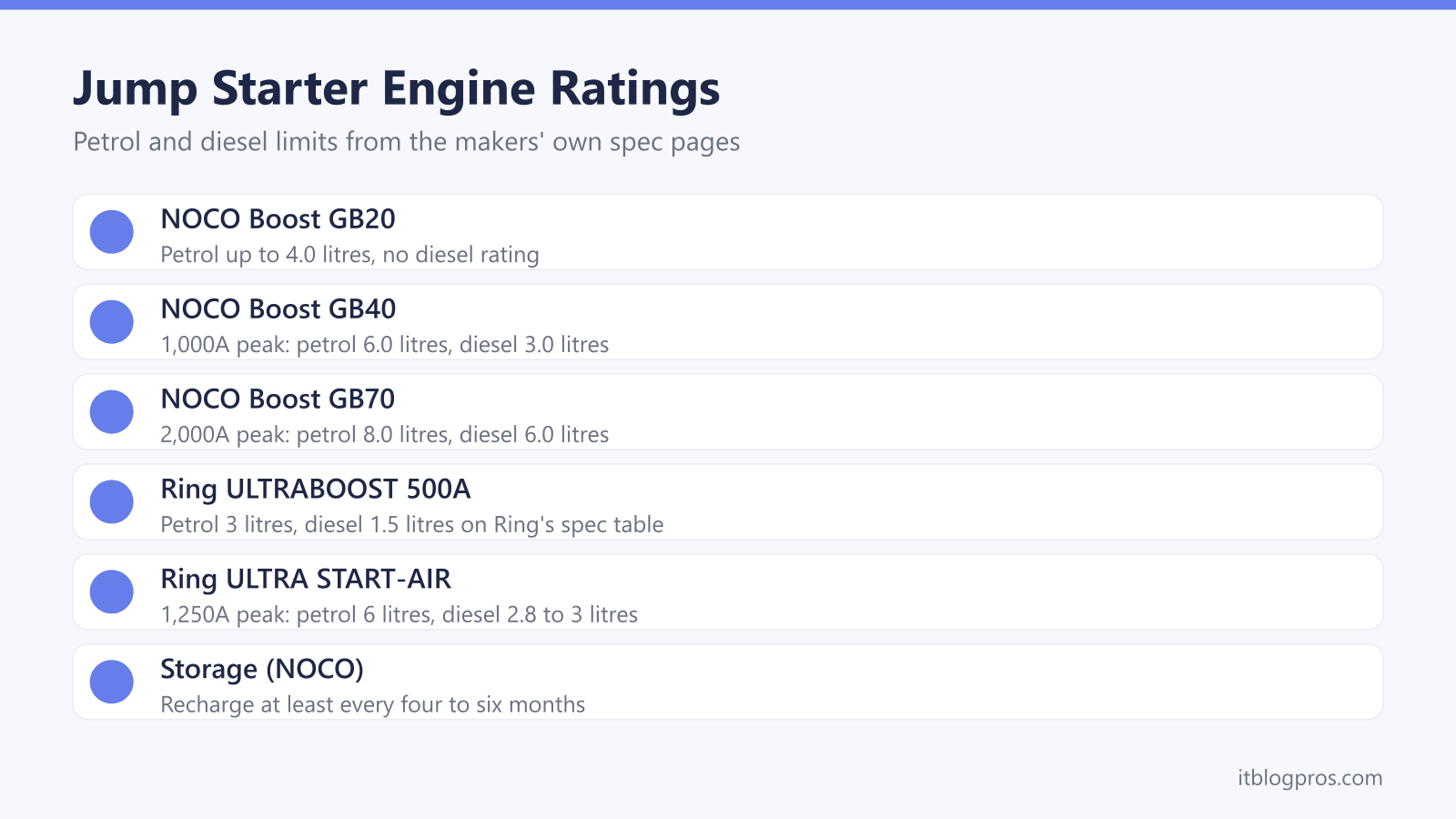
Fuel type matters as much as size. NOCO's chart rates the GB40 for petrol engines up to 6.0 litres but diesel engines only up to 3.0 litres, and the GB70 for 8.0 litres of petrol or 6.0 litres of diesel. The smallest GB20 carries a 4.0-litre petrol rating and no diesel rating at all. NOCO's pages say gasoline, the American word for petrol.
Ring Automotive follows the same pattern. Its spec table for the ULTRABOOST 500A lists petrol engines up to 3 litres and diesels up to 1.5 litres, although the description on the same page says 1.6 litres.
Neither maker gives figures for engines above a pack's rating, so buy to the rating for your fuel.
Peak Amps Are a Split-Second Figure
The big number on every box is peak amps: 1,000A for the GB40, 2,000A for the GB70, 500A for Ring's smallest ULTRABOOST. Ring's user guide for the 1500A ULTRABOOST shows what that figure covers. It rates the pack at 1,500A for 0.1 seconds and 350A for three seconds, so the headline number is a burst lasting a tenth of a second.
Ring's product pages list both figures for each model. The 500A pack gives a starting current of 200A, and the 1,250A ULTRA START-AIR gives 275A. NOCO's spec tables give a single figure, listing the GB40's starting current as 1,000 amps peak.
The useful comparison is the engine rating, not the amps. NOCO rates the 1,000A GB40 for 6.0-litre petrol and 3.0-litre diesel engines, while Ring quotes 1,500A peak for the same 6-litre and 3-litre rating on its ULTRABOOST. Within one brand, more amps buys a bigger engine rating. Across brands, the amp figures do not line up, so compare the litres for your fuel type instead.
Spark and Polarity Protection Make Jump Starting Safer
Jump leads punish two mistakes: clamps on the wrong terminals and clamps touching each other. NOCO and Ring both build in protection against them. NOCO's FAQ says nothing happens if the clamps touch, because spark-proof sensors stop power flowing until a battery is detected. Connect them backwards and, by NOCO's account, an error light comes on and the pack will not deliver power.
NOCO flags one exception. Its packs detect batteries down to 2 volts, and below that a Manual Override mode forces the power on; in that mode, NOCO warns, the clamps must not touch. Ring's ULTRABOOST packs have a boost button that Ring says starts vehicles with completely depleted batteries, and Ring lists reverse polarity protection and a spark-free design under its Ringtelligence name.
Check the battery type too. NOCO says Boost packs only jump 12V lead-acid batteries, including EFB and AGM types, and should not be used on a lithium car battery. Ring's ULTRA START-AIR page says it suits START/STOP batteries. On a dark evening, a head torch keeps both hands free for the clamps.
Makers Set the Storage, Charging and Cold Limits
A jump starter can sit in the boot for months. NOCO says its Boost packs hold 70% of their rated capacity for up to a year, but recommends charging them at least every four to six months. Ring's battery guide says a lithium power pack holds its charge for up to 12 months. NOCO says its packs arrive partially charged and need a full charge before first use, and Ring's user guide says to always charge before use.
Temperature is the other limit. NOCO gives an operating range of -20°C to 50°C for every Boost model, with thermal sensors that stop the pack working outside it, and says to recharge only between 0°C and 40°C. Ring's user guide for the 1500A ULTRABOOST gives -20°C to 55°C for use and a narrower 0°C to 20°C for charging, and warns against use in extreme cold.
Heat matters too. NOCO warns that a car in direct sunlight can reach 50°C inside within 10 minutes. Keep the pack out of the sun, and bring it indoors to recharge on a cold night.
Cordless Tyre Inflators Need the Car's Own Pressure Figure
Cold snaps hit tyres as well as batteries. The AA's tyre pressure advice says a sudden cold spell can trigger a loss of pressure, and recommends checking every couple of weeks and whenever the weather changes sharply. Check with cold tyres, which the AA defines as the car not having been driven for a couple of hours.
The right figure is the car's, not the inflator's. The AA says the handbook lists it, with a sticker usually inside the fuel filler flap or on the driver's door edge, often with a higher figure for full loads. Xiaomi's Air Compressor 2 Pro has a car mode that defaults to 2.5 bar, adjustable from 1.8 to 3.5 bar, so set it to the sticker figure. Xiaomi quotes about 45 seconds to take a 205/55 R16 tyre from 2.0 to 2.5 bar, measured at around 25°C.
Combined units save boot space. Ring's ULTRA START-AIR pairs a jump starter with an auto-stop inflator, and NOCO's Boost Air AX65 pairs a 2,000A jump starter with a 100 PSI compressor.
A Jump Start Will Not Fix a Worn-Out Battery
A jump starter gets the car going; it does not mend the battery. NOCO says plainly that Boost is not a battery charger, and points owners to its Genius chargers. Ring's battery guide explains why winter is hard on batteries: as the temperature drops, the electrolyte is less able to deliver full power.
The AA's flat battery advice gives the clearest test. If jump starting does not work, the AA says, the car needs a new battery. Most batteries last somewhere between five and seven years, by the AA's account. A car that struggles to start before then probably has a battery that is not getting enough charge, too many short journeys or a fault draining it; past five years, the AA says, the battery is getting tired and may need replacing.
The AA also calls a jump start on a dead battery a temporary measure, to be followed by a garage visit. For upkeep, Ring recommends a smart charger every three months, and the AA says EFB and AGM batteries need a smart charger.
Five Picks From Small Petrol Cars to Big Diesels
NOCO's GB40 is the main pick for most petrol cars, rated for 6.0 litres of petrol and 3.0 litres of diesel. Bigger diesels need the GB70, which NOCO rates for diesels up to 6.0 litres and fits with a 12V output that can run a compressor. NOCO's own figures for its weight disagree: the spec table says 1.9 kg, the overview 5.0 pounds.
Ring's ULTRABOOST 500A is the budget choice for small petrol cars, and suits only diesels up to 1.5 litres. Ring's ULTRA START-AIR adds an inflator, though Ring's page gives its diesel limit as both 3 litres and 2.8 litres, so work to the lower figure. Xiaomi's Air Compressor 2 Pro is the standalone inflator, rated for about 16 top-ups from 2.0 to 2.5 bar per charge.
All four jump starters have a USB port for a phone. NOCO's GB40 page promises up to four smartphone recharges while its FAQ says about two, so carry a power bank for daily use, or a portable power station for running kit for hours.
| Product | Best for | Key specs | Price | |
|---|---|---|---|---|
 | NOCO Boost GB40 1000A UltraSafe Lithium Jump Starter Our pick | Petrol up to 6.0 litres, diesel up to 3.0 litres | 1,000A peak, 24Wh lithium, USB 2.1A, IP65, 1.11 kg | Check price → |
 | NOCO Boost GB70 2000A Jump Starter with Boost X EVA Case Big diesels | Diesel up to 6.0 litres, petrol up to 8.0 litres | 2,000A peak, 56Wh lithium, 12V 15A output, IP65, with GBC104 EVA case | Check price → |
 | Ring ULTRABOOST 500A Lithium Jump Starter (RJS010) Budget | Small petrol cars up to 3 litres | 500A peak, 200A starting, 6000mAh, USB-A, LED torch | Check price → |
 | Ring ULTRA START-AIR Jump Starter and Tyre Inflator (RJSTI030) Two in one | One box for jump starts and tyre top-ups | 1,250A peak, 275A starting, 12000mAh, auto-stop inflator | Check price → |
 | Xiaomi Portable Electric Air Compressor 2 Pro Inflator | Topping up tyres without a 12V cable | 3 to 150 PSI, auto-stop, 27Wh, -10°C to 45°C use | Check price → |